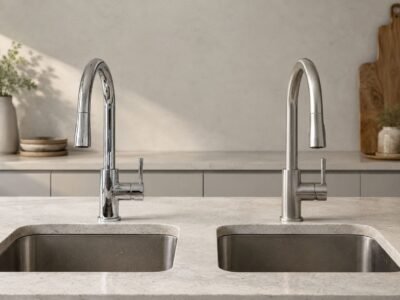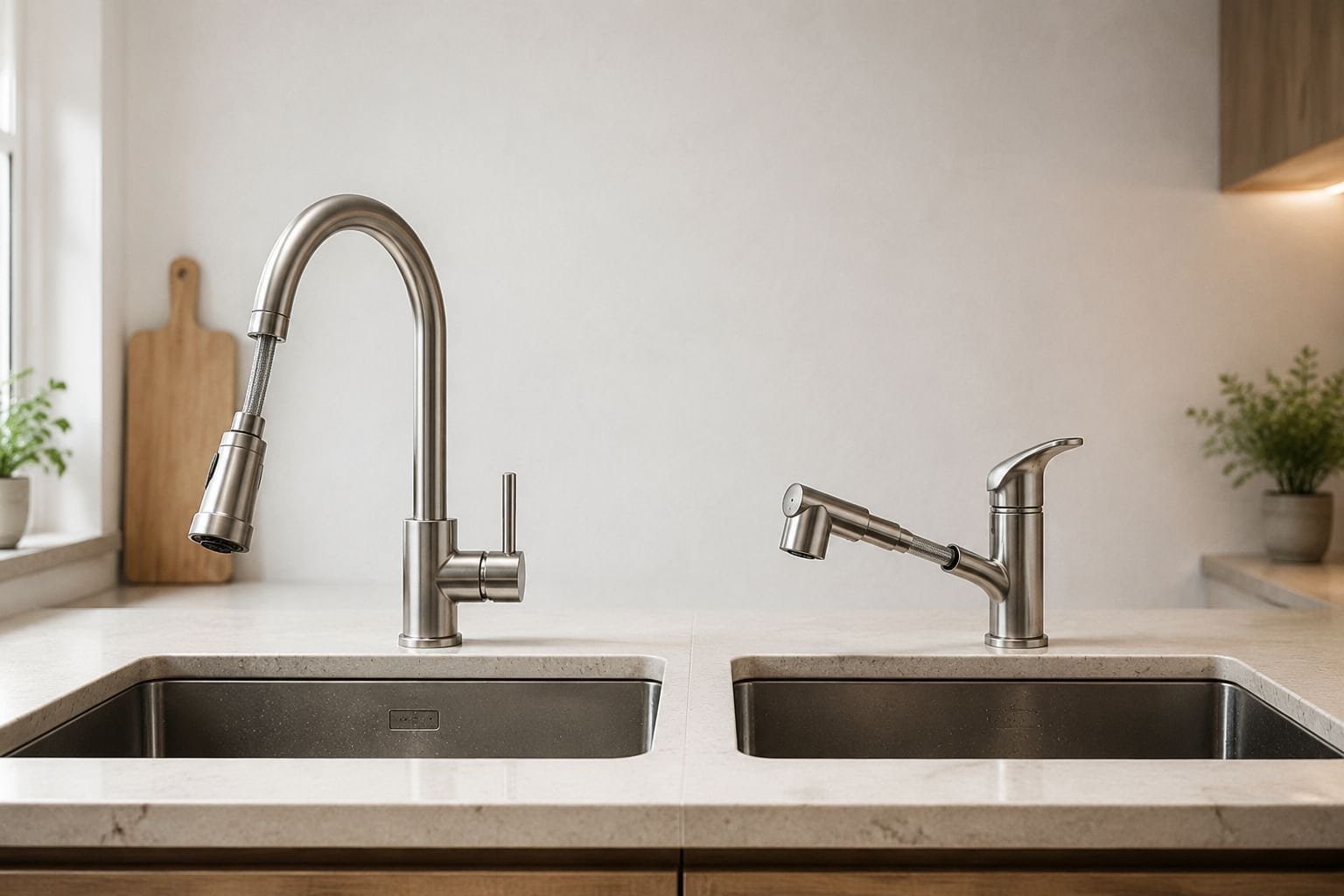
Choosing between a pull-down and pull-out kitchen faucet is mainly about sink size, clearance, and reach—not appearance alone. Pull-down faucets usually have a higher arc and direct the spray head down into the basin, making them well suited to deep sinks and bulky cookware. Pull-out faucets generally have a lower profile and extend toward the user, which can be useful with shallow sinks, limited space above the sink, or containers placed beside the basin.
The quick rule is simple: choose a pull-down faucet for more room beneath the spout and sink-focused rinsing; choose a pull-out faucet for a compact profile and more natural horizontal reach. In either case, compare the actual faucet height, spout reach, hose length, docking system, and under-sink routing before buying.
What’s the Difference Between Pull-Down and Pull-Out Faucets?
How Pull-Down Faucets Work
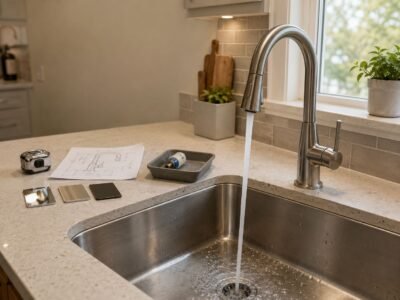
A pull-down faucet usually has a high-arc spout and a spray head that pulls downward into the sink. The taller arc creates more clearance between the outlet and the basin, making it easier to position stockpots, baking trays, and other bulky cookware beneath the faucet. However, the higher profile also requires more space above the sink, so check the distance to any shelf, window trim, or wall cabinet before buying.
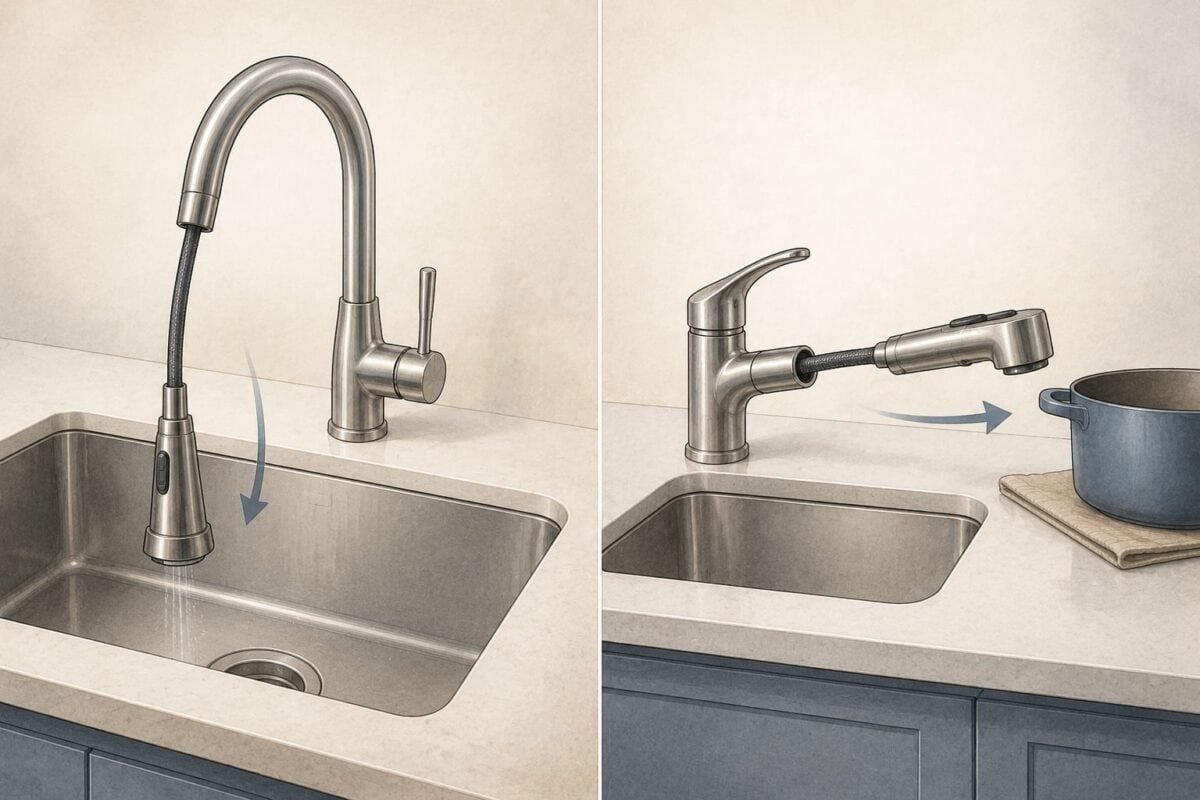
The direction of movement also affects daily use. Because the spray head pulls downward, most rinsing tasks remain centered over the basin, helping keep the hose and spray pattern within the sink area. This movement is especially practical when rinsing large cookware, cleaning the corners of a deep basin, or directing food debris toward the drain.
How Pull-Out Faucets Work
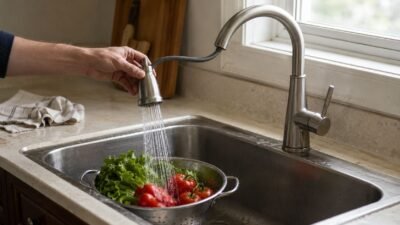
A pull-out faucet usually has a lower spout and a spray wand that pulls outward or slightly upward. Its compact profile can work well with shallow sinks or in spaces where a shelf, window trim, or wall cabinet limits the available height above the sink. The outward pulling motion can also make it convenient to fill a pot or bucket placed beside the basin.
Because the spray wand extends toward the user, a pull-out faucet can be convenient in compact work areas where the hose frequently needs to reach beyond the edge of the sink. However, the lower spout may provide less clearance for tall pots, so the actual spout height should still be checked before buying.
Pull-Down vs. Pull-Out Faucet Comparison
| Recurso | Pull-Down Faucet | Pull-Out Faucet |
|---|---|---|
| Typical spout profile | Higher arc | Lower, more compact profile |
| Spray head movement | Pulls downward into the sink | Pulls outward or slightly upward |
| Best suited for | Deep sinks and large cookware | Compact or shallow sinks and limited overhead space |
| Main advantage | More clearance beneath the spout | Easier reach toward the countertop |
| Main limitation | Requires more space above the sink | Less clearance beneath the spout |
| Important checks | Overall height, splash, docking, hose routing | Spout height, extended reach, docking, hose routing |
Internal Mechanism and Docking Systems Compared
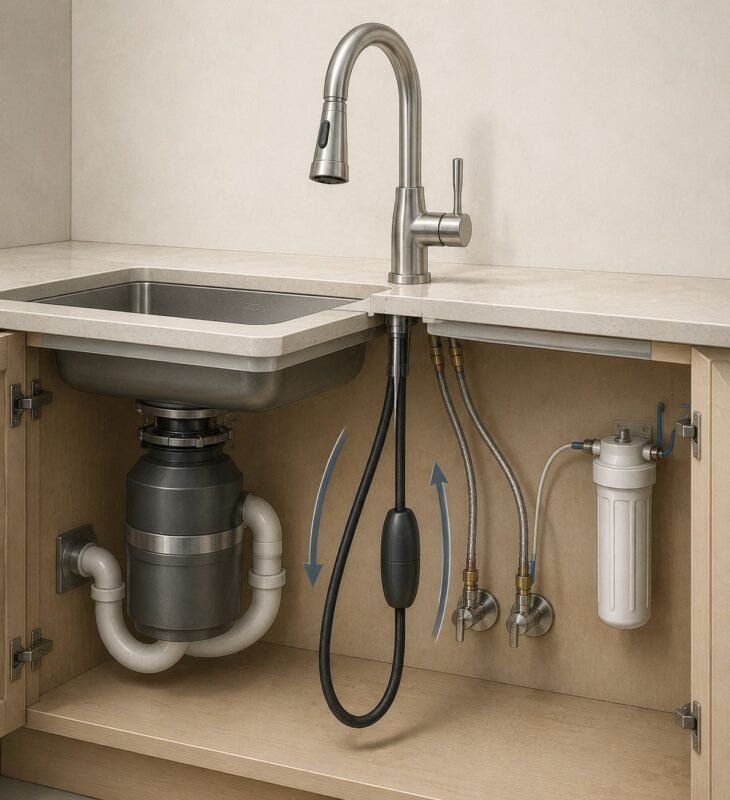
Both designs route a retractable hose through the faucet body and into the cabinet below. In many models, a counterweight helps pull the hose back into the cabinet, while a magnetic or mechanical docking system holds the spray head securely against the spout.
Smooth operation depends more on hose quality, counterweight placement, docking design, and a clear path below the sink than on whether the faucet is classified as pull-down or pull-out. Because hose lengths vary by model, compare the manufacturer’s specifications instead of assuming that one style always provides greater reach.
Durability depends on more than whether a faucet is pull-down or pull-out. ASME A112.18.1/CSA B125.1 covers kitchen and sink supply fittings, so recognized standards and model-specific specifications are more useful indicators than faucet style alone.
Pros and Cons of Pull-Down and Pull-Out Faucets
Strengths and Weaknesses of Pull-Down Faucets
Pull-down faucets are especially useful when you regularly wash large cookware. Their high arc creates more clearance beneath the spout and directs the spray into the basin, making them practical for rinsing stockpots, baking trays, and deep sinks. The tradeoff is that the faucet requires more vertical space above the deck and may produce more splash when paired with a shallow basin.
If a pull-down design matches your sink size and cooking habits, explore our Torneiras de cozinha suspensas to compare spout heights, spray functions, finishes, and docking systems. Checking the actual product dimensions can help you narrow the options before measuring the final installation space.
For frequent family use, look for a kink-resistant hose, smooth retraction, and a docking system that holds the spray head securely without wobbling. These functional details are generally more important in daily use than decorative styling or finish alone.
Strengths and Weaknesses of Pull-Out Faucets
Pull-out faucets can be a practical choice for compact kitchens because their lower profile occupies less vertical space above the sink. They work well beneath low wall cabinets, shelves, or window trim and are convenient when filling containers placed on the countertop beside the basin.
For kitchens with limited space above the sink or a need for more outward hose reach, browse our torneiras extraíveis para cozinha and compare their spout height, extended reach, spray modes, and installation requirements. A lower profile can be especially useful beneath shelves, window trim, or low wall cabinets.
The main limitation is the lower spout height, which can leave less room for tall cookware beneath the outlet. Hose reach and retraction also vary by model. Both pull-down and pull-out hoses can snag if the counterweight or hose contacts supply lines, a garbage disposal, a filtration system, a pull-out waste bin, or stored items.
When choosing between the two styles, compare the actual overall height, spout height, spout reach, handle clearance, and extended hose reach rather than relying on the product category alone.
Key Factors and Installation Checks for Pull-Down vs Pull-Out Faucets
What to Measure Before Choosing a Pull-Down or Pull-Out Faucet
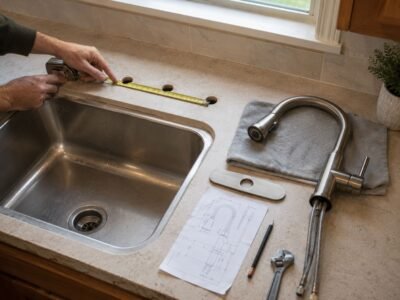
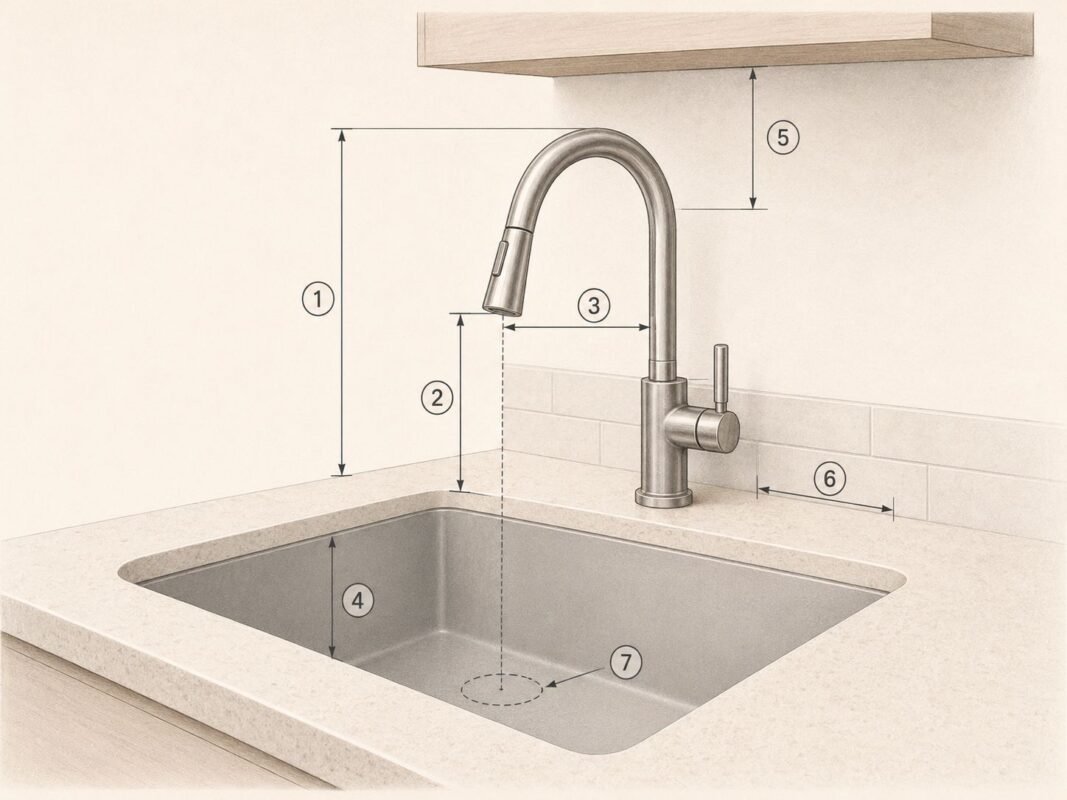
Measure the sink depth, bowl width, mounting area, and available space above and behind the sink. Record the faucet’s overall height, spout height, spout reach, handle movement, and rotation angle. Also measure the distance from the mounting-hole center to the backsplash and confirm that the water stream will fall near the center of the basin rather than too close to the front or rear wall.
For a double-bowl sink, confirm that the rotating spout and extended spray hose can comfortably reach both basins without pulling the hose to its limit.
Measure the sink depth, mounting area, and available space above and behind the sink. Record the faucet’s overall height, spout height, spout reach, handle movement, and rotation angle. For a double-bowl sink, confirm that the spout and extended hose can reach both basins without pulling the hose to its limit.
Faucet type is only one part of the decision. Mounting style, sink dimensions, water flow, handle clearance, and everyday cooking habits also affect whether a model will work well in your kitchen. For a broader checklist, see our guide on how to choose the best kitchen faucet for your sink.
Deck Hole Configuration and Installation Basics
Before buying, count the mounting holes and confirm their spacing. Many single-handle faucets install through one center hole and can also be used on a three-hole sink with a compatible escutcheon. However, the plate may be included, sold separately, or unavailable for a particular model.
Extra holes may also be used for a soap dispenser, filtered-water faucet, or matching hole covers. Check the required hole diameter, hole spacing, maximum deck thickness, supply-line connections, and access for the mounting hardware before ordering.
If you are replacing an existing faucet, review a complete kitchen faucet installation guide before ordering. This will help you confirm the condition of the shutoff valves, the available mounting access, the required tools, and whether the existing supply connections are compatible with the new faucet.
When comparing an A-TORNEIRA faucet with other options, check whether the package includes the required deck plate, supply lines, mounting hardware, and hose weight. Clear installation instructions and access to compatible replacement cartridges, hoses, and spray heads are more important over time than decorative details alone.
Common Hose, Docking, and Leak Problems in Both Faucet Types
Hose Retraction, Docking Failures, and Leak Prevention
A common complaint with both pull-down and pull-out faucets is incomplete hose retraction. First check whether the counterweight is installed in the specified position and whether the hose can move without contacting supply lines, a garbage disposal, a filtration system, or stored items. If the model uses magnetic docking, inspect the spray head and dock for damage or mineral buildup.
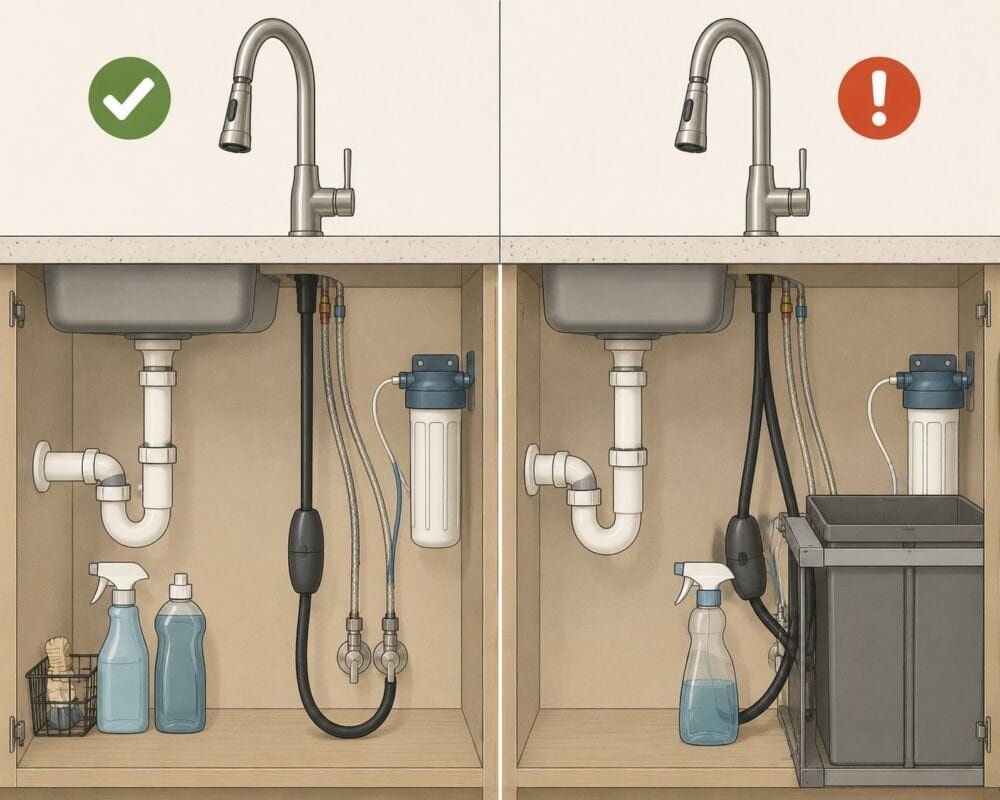
A bad counterweight location can make the faucet feel broken even when nothing is actually broken. I have seen a weight sitting too high, too low, or caught behind a supply line. Once the hose has a clear path, the whole faucet often behaves better immediately.
Leak diagnosis should begin with the location of the water. A leak between the spray head and hose may come from a loose connection or damaged seal. Water beneath the sink may indicate a problem with the retractable hose, quick-connect fitting, or supply line. Continuous dripping from the outlet after the faucet is turned off often points to the valve or cartridge. Turn off the water supply before disconnecting any hose and follow the service instructions for the specific model.
Build Quality and Maintenance for Frequent Daily Use
A faucet in a busy kitchen is exposed to frequent pulling, twisting, cleaning, water pressure changes, and mineral deposits. For that reason, internal construction matters as much as the exterior finish. A smooth ceramic cartridge, a kink-resistant hose, secure connections, and a docking system that holds the spray head firmly can provide better long-term performance than decorative features alone.
A 2025 study of faucets used for 3 to 25 years found that brass composition and drinking-water quality both affected dezincification. This means internal materials can matter as much as the exterior finish when comparing long-term durability.
For routine maintenance, clean the spray nozzles and remove mineral buildup before it becomes difficult to clear. If flow becomes uneven or noticeably weaker, check the spray-head screen and clean the spray head according to the manufacturer’s instructions. Replace the spray head or aerator only with a compatible part specified for that faucet model.
For most kitchens with a deep sink and enough space above it, a pull-down faucet is usually the more versatile choice. Choose a pull-out faucet when you need a lower profile, have a shallow or compact sink, or frequently fill containers beside the basin.
Do not decide by appearance or faucet type alone. Compare the actual dimensions, hose reach, rotation, docking system, installation requirements, and replacement-part availability before making the final choice.
Which Is Better: A Pull-Down or Pull-Out Faucet?
For most kitchens with a deep sink, sufficient overhead clearance, and regular large-cookware washing needs, a pull-down faucet is usually the more versatile choice. Its high arc provides more space beneath the spout, while the downward spray movement keeps most rinsing tasks inside the basin.
A pull-out faucet is generally the better choice when the sink area has limited vertical space, the basin is shallow or compact, or the spray hose frequently needs to reach containers beside the sink.
Do not decide by appearance or faucet type alone. Compare the actual dimensions, spout reach, extended hose reach, rotation angle, docking system, installation requirements, warranty, and replacement-part availability before making the final choice.