When people ask me what the best type of kitchen sink faucet is, I do not start with the finish. I start with how the sink is used. A faucet can look perfect in a photo but still be frustrating in daily use if the spout height and reach are wrong, the handle lacks clearance, or the internal components are difficult to service.
I narrow the choice down with four questions: What spout height and reach fit the sink? What handle configuration fits your routine, and would electronic activation be useful? What mounting holes and clearances are available? And are the cartridge, spray head, hose, and other replacement parts easy to obtain?
There is no single best faucet for every kitchen. For most households, a single-handle pull-down faucet with a ceramic-disc cartridge, third-party certification for drinking-water contact, and readily available replacement parts offers the best balance of reach, convenience, and long-term value. A pull-out faucet may be the better fit when the sink is compact or overhead clearance is limited.
Quick Comparison of Kitchen Faucet Features
| Tipo de torneira | Melhor para | Principal vantagem | Check Before Buying |
|---|---|---|---|
| Puxar para baixo | Deep or large sinks | Easy cookware rinsing | Height, splash, docking |
| Extensão | Compact sinks or limited height | Controlled forward reach | Hose length and retraction |
| Single-handle | Most everyday kitchens | Fast one-hand operation | Folga da alça |
| Duas alças | Traditional layouts | Separate hot/cold control | Hole count and spacing |
| Motion-sensor | Messy food preparation | Hands-free operation | Power and manual override |
| Touch-activated | Users wanting intentional electronic control | Reduced handle use | Touch area and power source |
Pull-Down vs. Pull-Out: Which Kitchen Faucet Spray Style Fits Your Sink?
When a Pull-Down Faucet Makes Sense
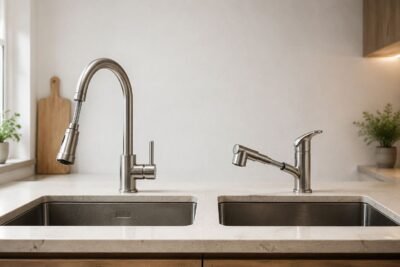
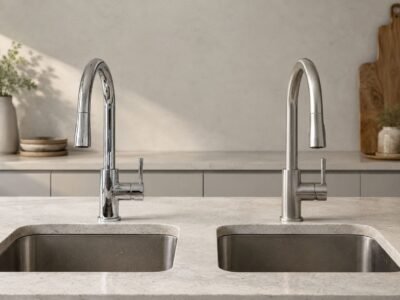
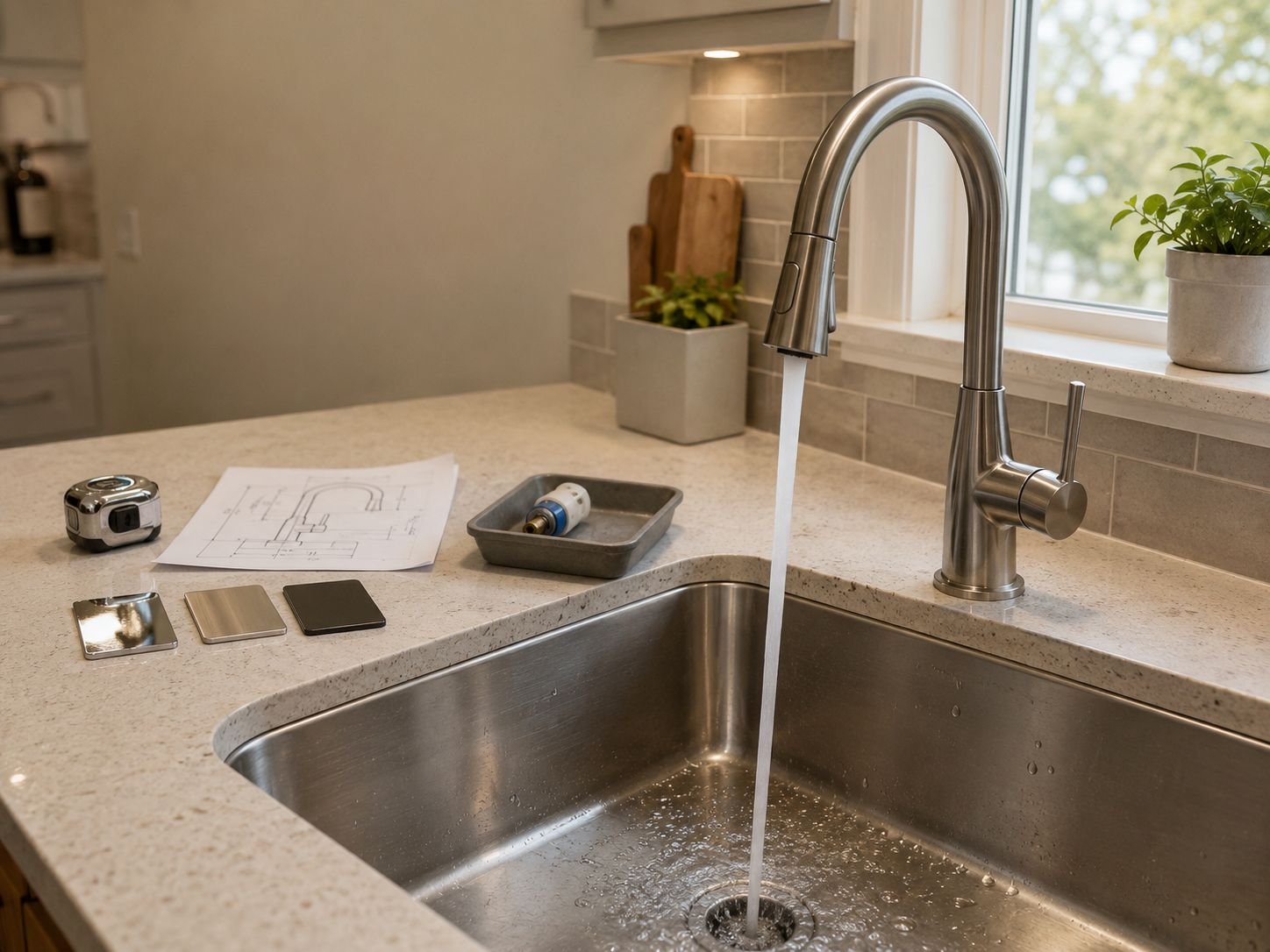
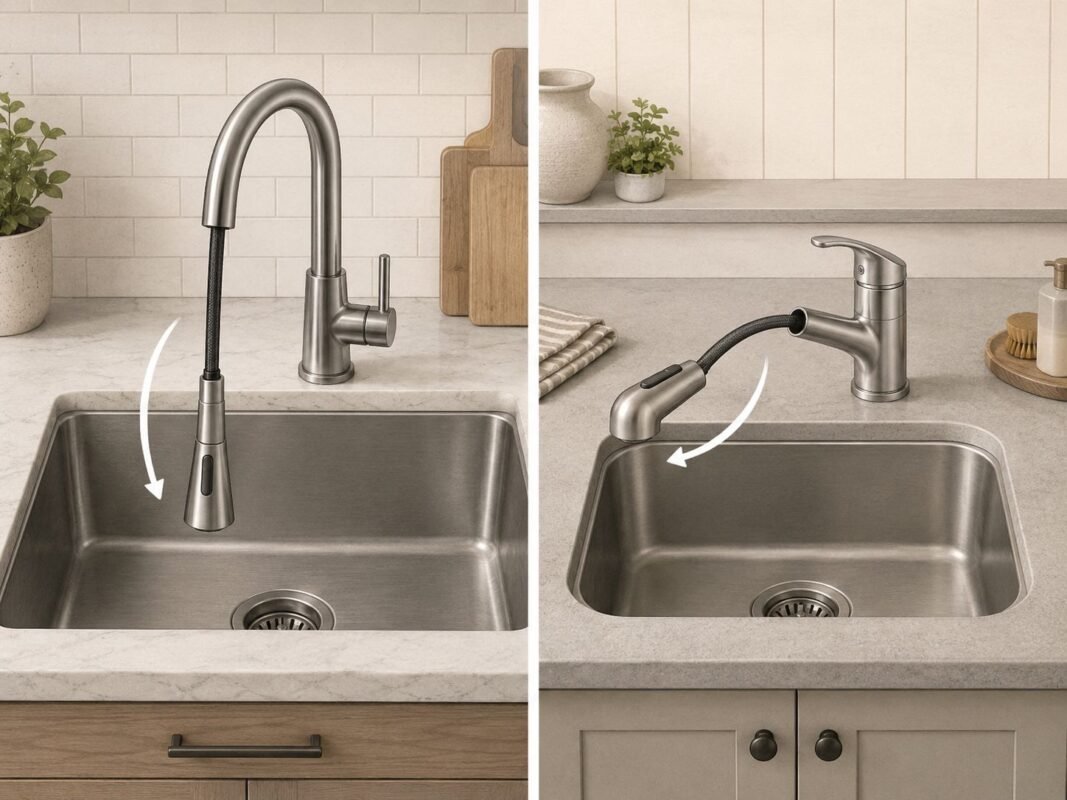
Pull-down faucets commonly use a high-arc spout and are well suited to deep or large sinks. The spray head pulls downward into the basin, making it convenient to rinse cookware and reach the corners of the sink. Before buying, check the faucet’s overall height, spout reach, swivel range, hose length, and docking system. A high arc can increase splashing when it is paired with a shallow basin or when the water lands too close to the front of the sink.
If you want to compare different spout heights and hose types, browse our pull-down kitchen faucet selection to find what fits your setup.
When a Pull-Out Faucet Is the Better Choice
Pull-out faucets usually have a lower-profile spout, and the spray head pulls toward the user rather than straight down. They can work well with compact sinks or in locations with limited vertical clearance. However, the decision should be based on actual dimensions rather than kitchen size alone. Check the hose reach, retraction system, spout-to-drain alignment, and under-sink clearance for the hose and counterweight.
In a narrow kitchen, a lower-profile pull-out faucet can reduce visual crowding while still providing useful hose reach. Confirm that the spout reaches the center of the basin and that the hose can move freely below the sink before making the final choice.
Single-Handle, Two-Handle, and Touchless: Control Options That Fit Your Routine
Why Single-Handle Is the Modern Standard
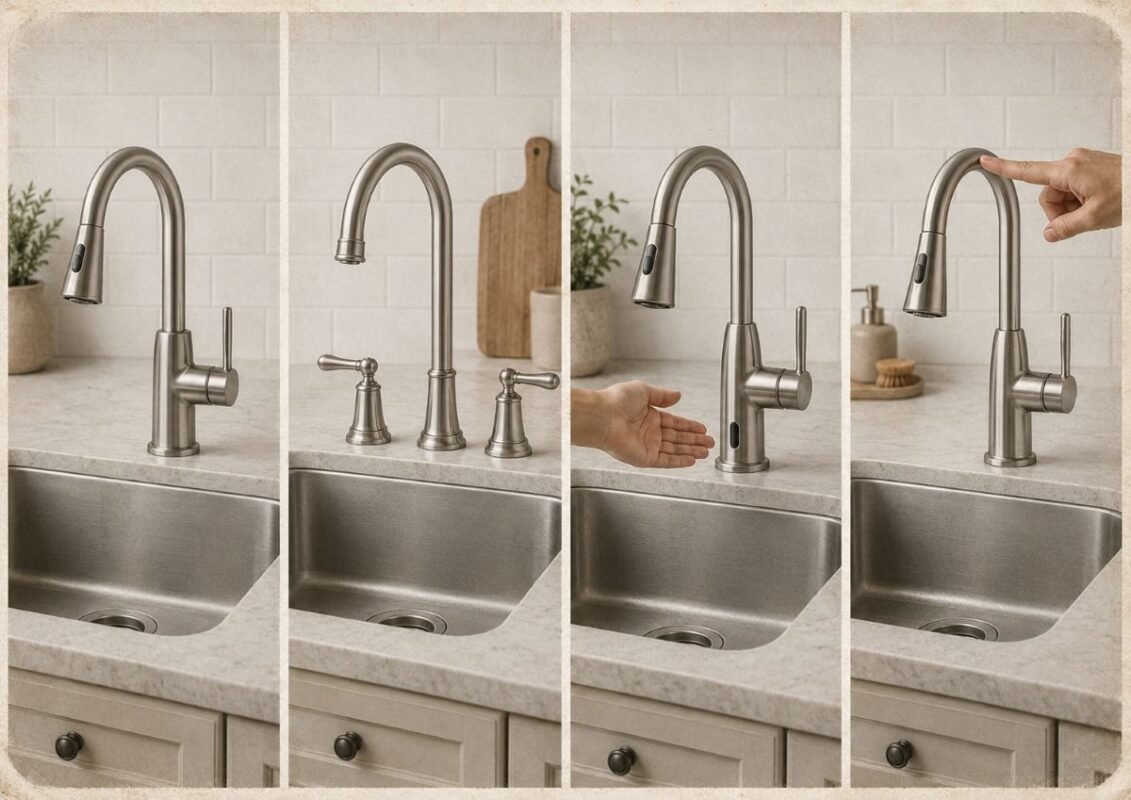
Single-handle kitchen faucets combine flow and temperature control in one lever, making them convenient when the other hand is holding cookware, food, or a cleaning tool. They also simplify the area around the sink, especially when the deck already includes a soap dispenser or filtered-water faucet. A well-made cartridge can provide precise temperature and flow control, while two-handle designs require separate hot and cold adjustment and create more surfaces to clean.
When Two-Handle Designs Still Make Sense
Two-handle faucets remain a practical option for traditional kitchens and for users who prefer separate hot and cold adjustment. They can also complement a classic interior, provided the existing sink or countertop has a compatible mounting layout.
Two-handle kitchen faucets often require two or three mounting holes, depending on whether the spout and handles share a base or are installed separately. Confirm the hole count, center-to-center spacing, hole diameter, and deck thickness before buying. If the existing sink does not have a compatible layout, adding extra holes solely for appearance may not be worth the added installation work.
Hands-Free Motion-Sensor vs. Touch-Activated Faucets
Motion-sensor and touch-activated faucets are two different electronic control systems. A motion-sensor faucet starts water without physical contact, while a touch-activated faucet responds when you touch a designated part of the spout or body. Motion sensing is useful when your hands are messy, while touch activation may provide more intentional control and reduce accidental triggering.
For either type, check the sensor location, battery or AC power requirements, manual override, automatic shutoff, warranty coverage, and availability of replacement electronic components. Electronic control is most valuable when it solves a real workflow or accessibility need, rather than simply adding another feature.
How to Match Your Faucet to Your Sink Setup
Counting Sink Holes and Understanding Mounting Options
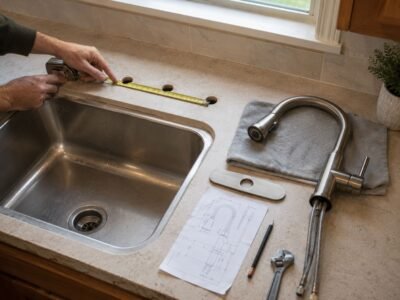
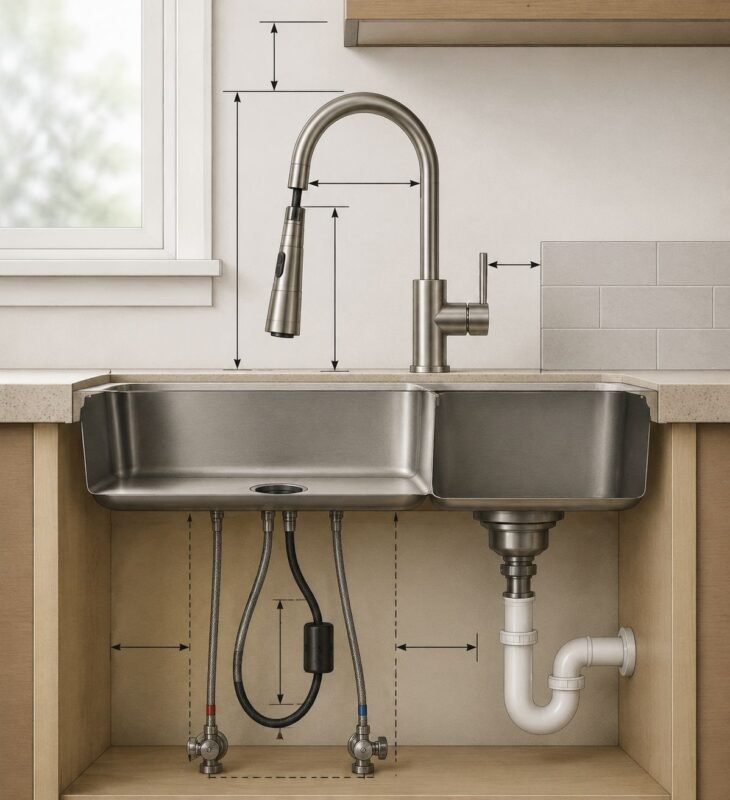
Before buying a kitchen faucet, check more than the number of mounting holes. Record the hole count, hole diameter, center-to-center spacing, deck thickness, distance to the backsplash, handle clearance, and available space below the sink. A one-hole, two-hole, three-hole, or four-hole layout can limit which faucet and accessories will fit without additional drilling.
A deck plate may cover unused adjacent holes, but only when its length and the existing hole spacing are compatible. Other unused holes may be fitted with a soap dispenser, filtered-water faucet, air gap, or individual hole cover. Wall-mounted kitchen faucets require correctly positioned in-wall supplies, an appropriate rough-in depth, and careful alignment between the spout and sink basin.
Sink Depth, Backsplash Clearance, and Faucet Height
Faucet height matters, but spout reach and outlet position matter just as much. A high-arc faucet can cause splashing over a shallow basin if the water lands too close to the front or strikes the side wall of the sink. A low spout can limit clearance for large cookware. Check the total faucet height, spout reach, outlet angle, handle travel, swivel range, and the distance from the outlet to the drain.
I think of this section as the reality check. The best type of sink faucet is not always the fanciest one. It’s the one that clears the room, fits the sink, and still leaves space to work. When the dimensions are right, daily use feels smooth without you even thinking about it. And when you’re ready to narrow things down, browsing a well-organized coleção de torneiras para pia de cozinha helps you compare mounting types, hole counts, and heights side by side.
Best Sink Faucet Materials and Valve Technology for Long-Term Value
Solid Brass vs. Zinc Alloy vs. Stainless Steel: What’s Inside Your Faucet
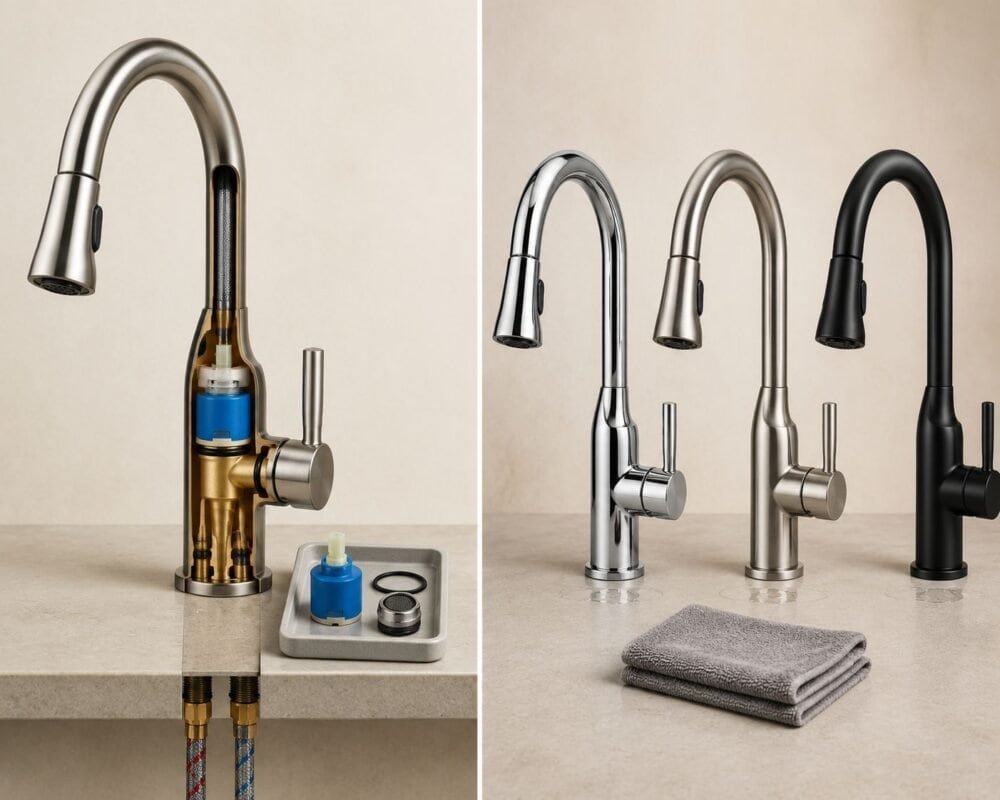
When evaluating faucet materials, separate the exterior body, the internal waterway, and the surface finish. Brass and stainless-steel waterways are common durable choices when they are properly manufactured and certified. Zinc alloy may be acceptable for handles or decorative outer components, but it is less desirable for heavily stressed or continuously wetted parts.
Product weight alone is not a reliable quality test. A heavier faucet is not automatically better, and a lighter faucet may use engineered waterways or nonmetallic components designed for drinking-water applications. Check the material specifications, product certifications, warranty, and availability of replacement parts rather than judging only by weight or appearance.
For a kitchen faucet used for drinking water, do not rely only on the words “lead-free brass” or “stainless steel.” Look for third-party certification to NSF/ANSI/CAN 61 for drinking-water health effects and NSF/ANSI/CAN 372 for lead-content compliance. Under U.S. requirements, “lead free” means no more than a 0.25% weighted average lead content across wetted surfaces; it does not mean absolutely zero lead. Mechanical performance certification to ASME A112.18.1/CSA B125.1 is also worth checking.
Ceramic-Disc Cartridges: Why Serviceability Matters
Many modern kitchen faucets use a ceramic-disc cartridge, which combines the sealing surfaces and control components in a replaceable assembly. Ceramic discs are widely used because they can provide smooth control and good wear resistance under normal conditions.
It is misleading to contrast ceramic-disc valves with cartridge valves as if they were separate categories. A better comparison is between ceramic-disc cartridges and older compression, ball, or non-ceramic cartridge designs. Long-term performance depends not only on the valve type but also on water quality, manufacturing tolerances, installation, and whether the correct replacement cartridge remains available.
Finish Durability, Water Efficiency, and Ownership Costs
Chrome, Brushed Nickel, Matte Black: Which Finish Ages Best?
Finish color alone does not determine durability. Chrome is generally easy to clean and can be highly durable when the plating quality is good. Brushed finishes tend to hide fingerprints and water spots, while matte black may show mineral residue, scratches, or abrasion more clearly.
If durability is the priority, compare the coating process, finish warranty, and care instructions rather than relying only on the color name. A quality PVD finish may resist wear better than a basic painted or plated finish, but the manufacturer’s process and warranty matter more than whether the finish is labeled chrome, nickel, or black.
What to Budget for Maintenance, Repairs, and When to Replace
When comparing water efficiency, check the faucet’s listed flow rate, spray performance, aerator design, and resistance to mineral buildup. U.S. federal standards limit kitchen faucets to a maximum flow rate of 2.2 gpm, although some products and local regulations use lower limits.
Residential kitchen faucets are not currently eligible for the EPA WaterSense label, so do not treat a kitchen faucet as WaterSense certified. Instead, verify the stated flow rate and look for a spray pattern that performs effectively without encouraging the user to run the water longer.
Long-term ownership cost also depends on the warranty and the availability of cartridges, spray heads, hoses, aerators, batteries, and electronic control parts. A faucet that uses replaceable, easy-to-source components may offer better value than a cheaper model with proprietary or unavailable parts.
Repair is usually worthwhile when the problem is limited to a replaceable cartridge, aerator, spray hose, O-ring, battery pack, or sensor component. Replacement makes more sense when the faucet body is cracked or badly corroded, leaks return after a correct repair, compatible parts are no longer available, or the faucet no longer fits the sink layout or household needs.
For a deeper look at long-term value, my kitchen sinks and faucets buying guide covers materials, finishes, and what to budget for over time.
Choose the faucet that fits your sink before choosing the finish. For many kitchens, a single-handle pull-down model offers the best all-around convenience, while a pull-out faucet may fit better where the sink is compact or vertical clearance is limited. Before ordering, confirm the mounting dimensions, spout reach, product certifications, cartridge availability, finish warranty, and power requirements.
Explore A-TORNEIRA kitchen sink faucets by mounting type, spray-head design, finish, and installation requirements to find a model that fits your kitchen.