When I started helping customers around the world choose the “right” faucet, I realized something surprising: the debate between single-handle and double-handle faucets isn’t really about which one is “better.” It’s about lifestyle, habits, water conditions, installation reality, and even how you feel when you use the faucet every day.
In this guide, I’ll walk you through what single-handle and double-handle faucets are, their real pros and cons (not just textbook ones), where each design performs best, and how I personally recommend choosing—based on the practical experience we’ve built at A-TORNEIRA.
Before diving into the specific differences between these two types, it’s helpful to have a baseline knowledge of how faucets work internally. If you’re unfamiliar with the various components, check out our Understanding Faucet Structure: A Practical Guide to better visualize the mechanisms we’ll be discussing.
What Is a Single-Handle Faucet?
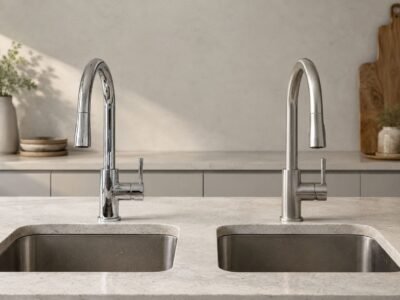
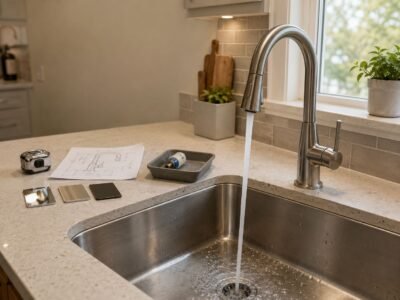
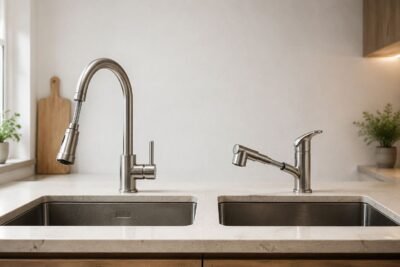
A single-handle faucet uses one lever (or joystick-style handle) to control both water flow and temperature. Move the handle up or down to control volume, and left or right to control hot/cold mixing.
This design is common in modern kitchens and bathrooms because it feels intuitive—especially if you’re multitasking. I’ve seen customers fall in love with single-handle faucets simply because they can adjust temperature with one hand while the other hand is busy.

Pros and Cons of Single-Handle Faucets
Pro 1: Fast, One-Handed Control
If you cook often, wash hands frequently, or simply value speed, a single-handle faucet is hard to beat. I personally like how quickly I can go from cold rinse to warm wash without a second thought.
This is also why many commercial-style kitchen faucets use a single lever: it supports fast operation.
Pro 2: Great for Accessibility and Universal Design
For families with kids, older adults, or anyone with limited hand strength, single-handle faucets can be easier to operate. A smooth lever motion usually requires less grip than twisting two knobs.
One of the primary advantages of single-handle faucets is their ease of use, which often makes them a preferred choice for Universal Design. Many of these models are designed to comply with ADA (Americans with Disabilities Act) standards, requiring less than 5 lbs of force to operate.
If you’re building a home with accessibility in mind, this detail matters more than people expect.
Pro 3: Cleaner, More Minimal Look
Single-handle faucets often look modern and uncluttered. With fewer components above the sink, the countertop feels visually lighter—especially in small bathrooms.
At A-TORNEIRA, many of our customers choose single-handle models for minimalist interior design themes.

Con 1: Temperature Can Be “Too Easy” to Change
Because one handle controls everything, it’s possible to accidentally change the temperature while adjusting flow—especially if the handle is loose, or if someone bumps it.
In homes with children, this can matter. If you’re worried about scalding, you can mitigate this with:
- a thermostatic mixing valve,
- anti-scald settings on the valve,
- or a faucet cartridge designed for stable temperature control.
Con 2: Cartridge Wear Affects Both Flow and Temperature
Single-handle faucets typically use a cartridge (ceramic disc or similar) that blends hot and cold inside one mechanism. When it wears out, you may notice:
- difficulty controlling temperature,
- drifting temperature,
- leaks around the handle.
Replacing a cartridge is usually straightforward, but it’s a “single point of failure” compared with dual-handle designs.
Con 3: Fine Temperature Tuning Can Take Practice
Some people love the simplicity. Others prefer the precision of two separate handles—especially if they’re sensitive to water temperature.
If you’re someone who likes “exactly warm, not hot,” a double-handle faucet can feel more natural.
What Is a Double-Handle Faucet?
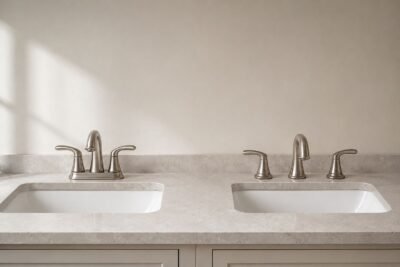
A double-handle faucet uses two separate controls—one for hot water, one for cold. The handles may be knobs, levers, or cross-style.
This design is classic in many regions and still widely used in bathrooms, utility sinks, and traditional-style kitchens. The temperature is controlled by adjusting how much hot and cold water you allow into the spout.
Honestly, I have a soft spot for double-handle faucets: the ritual of balancing hot and cold can feel more deliberate, almost comforting—especially in a classic home.

Pros and Cons of Double-Handle Faucets
Pro 1: Precise Temperature Control
With two handles, you can fine-tune water temperature by micro-adjusting hot and cold independently. Many users feel this gives them better control—especially when washing face, shaving, or doing delicate tasks.
Precise temperature control is one of the main reasons many prefer double-handle faucets. This control is crucial for maintaining safe water temperatures to prevent accidental scalding, especially in households with children or the elderly.
Pro 2: Less Accidental Temperature Change
Once you set the mix, it tends to stay stable. Turning water on again often returns to a similar temperature, especially if you open both handles to the same positions.
This can feel more predictable for daily routines.
Pro 3: Potentially Easier, Cheaper Repairs
Double-handle faucets often use separate valve mechanisms. If one side leaks (hot or cold), you may only need to service that side.
In many markets, replacement parts for traditional valve designs are also widely available.
Con 1: Slower Operation (Two Hands or Extra Steps)
If your hands are messy from cooking, soap, hair dye, or cleaning chemicals, adjusting two handles can be inconvenient.
In kitchen scenarios, this is the most common complaint I hear: users simply want water fast, without extra fiddling.
Con 2: More Cleaning and More Crevices
Two handles mean more surfaces. In hard water areas, mineral deposits build up around the handle bases, and cleaning takes more effort.
If you value easy maintenance, this may influence your decision more than you think.
Con 3: Requires More Installation Space (Often 3-Hole Sinks)
Many double-handle faucets are designed for three-hole configurations (hot handle, spout, cold handle). While there are widespread sink configurations to support this, it’s not always ideal for:
- modern single-hole countertops,
- compact basins,
- minimalist remodeling projects.
If your sink has one hole, adding a widespread double-handle faucet could require drilling or changing the basin—possible, but not always worth it.
While both single and double-handle faucets have their merits, choosing the wrong quality or material can lead to long-term headaches. To ensure you’re making a durable investment, take a moment to review these Faucet Pitfalls: 7 Types before finalizing your purchase.
Best Uses: When Single-Handle vs. Double-Handle Makes Sense
Kitchens: Single-Handle Usually Wins for Daily Efficiency
- turn the faucet on/off more times per day,
- need quick temperature shifts,
- want one-handed control while cooking.
In kitchens, I almost always recommend single-handle faucets—especially for busy households. You’ll likely:
A high-quality A-TORNEIRA single-handle kitchen faucet, paired with a durable ceramic cartridge, is a very practical long-term choice.
Best for kitchens when you have:
- frequent cooking,
- children washing hands often,
- a modern kitchen design,
- limited counter space.
Once you’ve decided which faucet style best fits your kitchen’s aesthetic and functional needs, the next step is installation. Whether you chose a sleek single-handle or a classic double-handle model, you can follow our How to Replace a Kitchen Sink Faucet to complete the project yourself.
Bathrooms: It Depends on Style and Routine
Bathrooms are more personal. Some people want fast, easy handwashing (single-handle). Others want comfort and control (double-handle).
Single-handle bathroom faucets are best for:
- guest bathrooms,
- minimalist designs,
- compact vanities,
- accessibility needs.
Double-handle bathroom faucets are best for:
- classic or vintage-style bathrooms,
- people who shave or do skincare routines with precise temperature preferences,
- households that prefer a stable “set and use” mixing style.

Utility and Laundry Sinks: Double-Handle Is Still Very Practical
For laundry rooms and utility sinks, double-handle faucets remain common because:
- the setup is often already 3-hole,
- replacement parts are easy to find,
- users like separate control for hot-heavy tasks (soaking) vs. cold-heavy tasks (rinsing).
Still, some modern homes are switching to single-handle for convenience—especially when paired with pull-down sprayers.
Families With Kids: Think About Safety and Habits
This is where I encourage honest thinking. With children:
- A single-handle faucet can be easier for kids to use correctly.
- But it may also be easier for kids to accidentally turn on hot water.
If child safety is a major concern, consider:
- anti-scald valves,
- temperature limit stops,
- faucets designed for stable temperature behavior.
At A-TORNEIRA, we prioritize smooth control and reliable internal components because “feel” and “safety” are not luxuries—they’re daily-life essentials.
Commercial or High-Traffic Spaces: Single-Handle for Speed, Special Designs for Durability
In restaurants, cafés, and public washrooms, speed and simplicity often dominate. Single-handle or sensor faucets are common choices.
However, durability becomes the deciding factor:
- strong brass body,
- corrosion resistance,
- proven cartridge quality,
- easy maintenance access.
How I Choose Between Them (My Practical Checklist)
1) Check Your Sink Hole Configuration First
Before anything else, I check how many installation holes the sink or countertop has.
- 1 hole: single-handle is easiest
- 3 holes: double-handle fits naturally, or use a deck plate for single-handle
- Widespread holes (8-inch spacing): double-handle widespread faucets are ideal
This one detail can save a lot of time and frustration.

2) Consider Water Hardness and Maintenance
If you live in a hard water area, ask yourself: “Do I want to clean around two handles, or just one?”
Mineral deposits don’t care about aesthetics. They build up wherever they can. Simpler surfaces are easier to maintain.
3) Think About Your Daily Hand Habits
This sounds funny, but it’s real.
If you often:
- wash hands while holding something,
- cook and need fast water changes,
- multitask in the kitchen,
then single-handle will likely feel more natural.
If you:
- like a stable temperature routine,
- prefer precise control,
- enjoy traditional design language,
double-handle may make you happier long-term.
4) Match the Faucet to the Room’s Design Language
A faucet can “finish” a room or make it feel mismatched.
- Modern, minimal interiors often look best with single-handle.
- Traditional, luxury, or vintage interiors often pair beautifully with double-handle.
At A-TORNEIRA, we design both styles so customers can choose based on function and aesthetics, without compromising quality.
Summary
Single-handle and double-handle faucets each have real strengths.
- Single-handle faucets shine in speed, convenience, accessibility, and modern design.
- Double-handle faucets excel in precise temperature control, classic style, and sometimes easier targeted repairs.
If I had to simplify it:
Choose single-handle for efficiency and modern living. Choose double-handle for precision and classic comfort.
And whichever you choose, quality matters more than handle count. Materials, cartridge design, corrosion resistance, and manufacturing standards will determine whether your faucet feels great for years—or becomes a daily annoyance.
That’s why A-TORNEIRA focuses on long-term usability and reliable internal components, not just surface-level style.
| Feature | Single-Handle Faucet (Pros) | Single-Handle Faucet (Cons) | Double-Handle Faucet (Pros) | Double-Handle Faucet (Cons) |
|---|---|---|---|---|
| Everyday operation | Fast, one-hand control for flow + temperature | Easier to accidentally shift temperature while adjusting flow | Stable “set-and-use” feel once both handles are positioned | Slower to operate (often needs two hands or extra steps) |
| Temperature control | Quick mixing with one lever | Fine temperature tuning can feel less precise for some users | Very precise temperature adjustment with separate hot/cold | Takes longer to reach the exact mix, especially from cold start |
| Accessibility | Generally easier for kids, seniors, and users with limited grip strength | If not set up with anti-scald limits, can be easier to push into hotter range | Separate handles can be intuitive for users used to traditional fixtures | Knobs/cross handles may require more grip and wrist rotation |
| Maintenance & repair | One cartridge to service; often a straightforward replacement | Cartridge is a single point of failure affecting both temp and flow | Hot/cold valves are separate; you may repair only the leaking side | More parts overall; two valves can mean more maintenance points |
| Leak risk (typical causes) | High-quality ceramic cartridge reduces dripping risk | Worn cartridge can cause handle leaks or temp drift | Traditional valve parts are widely available in many markets | Two handles = two potential leak sources (hot side and cold side) |
| Cleaning | Fewer crevices; often easier to wipe down | Mineral deposits can still build around the handle base | Classic shapes can be easy to grip and clean depending on design | More surfaces and edges to clean; hard water scale often forms around both handles |
| Installation compatibility | Best match for single-hole sinks; deck plate can cover 3-hole | May require deck plate or drilling if sink is set for widespread | Fits many 3-hole or widespread setups naturally | Often needs 3-hole or widespread spacing; not ideal for single-hole sinks without modification |
| Design & aesthetics | Modern, minimalist look; clean countertop profile | Some styles look less “classic” in traditional bathrooms | Timeless, traditional style; great for classic/vintage interiors | Can feel visually busy in minimalist spaces |
| Best-use scenarios | Busy kitchens, compact bathrooms, accessibility-focused spaces | Users who demand ultra-fine temperature precision may prefer two handles | Traditional bathrooms, grooming routines, users who like precise control | High-traffic kitchens where speed matters may find it inconvenient |