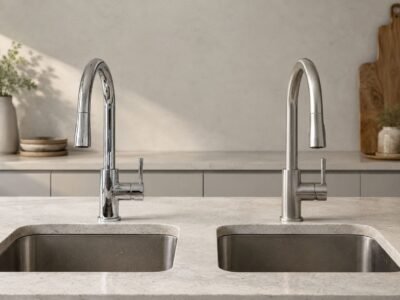
I start with the sink configuration, not the finish. A poor match can leave exposed holes, crowd the handles, or create backsplash clearance problems. A good match fits the existing drilling and looks intentional.
Before choosing a style, check the number of mounting holes, center-to-center spacing, deck thickness, backsplash clearance, and under-sink access. These details determine which faucet will install correctly.
Choose a centerset faucet for a compact three-hole, 4-inch sink and simpler installation. Choose a widespread faucet for an 8-inch-or-wider layout and a more separated appearance. For some 4-inch sinks, a mini-widespread faucet offers a third option.
For an overview of the main configurations, see our guide to bathroom faucet styles.
What Is a Centerset Faucet?
A centerset bathroom faucet is designed for a compact three-hole installation, usually with 4-inch spacing between the outer holes. The spout and handles are typically mounted on one shared base or closely integrated assembly.
If you already know you need a compact fit, I’d start with our centerset faucet collection.
How to Identify a Centerset Faucet
On a two-handle centerset faucet, the spout and handles form one compact assembly. A shared escutcheon usually covers all three mounting holes, but the hole spacing should still be measured before buying.
Key Features and Typical Dimensions
Most centerset bathroom faucets use 4-inch centers. Also check the maximum deck thickness, spout reach, and rear clearance, especially when the countertop is thick or the backsplash sits close to the mounting holes.
Handle design also affects daily use. Lever handles are often easier to operate than small knobs or cross handles, but accessibility depends on the exact model rather than the centerset layout itself.
Pros and Cons at a Glance
Centerset faucets are often less expensive and quicker to install because the components are grouped into one compact assembly. The shared base can simplify wiping, although mineral buildup may collect along its edges.
The tradeoff is flexibility. If you want more separation between handles and spout, or if you are chasing a more open, upscale look, centerset can feel a little boxed in. On a wide vanity, it sometimes reads as too compact for the space.
When an existing countertop has three holes on 4-inch centers, a centerset faucet is often the simplest replacement. It can reuse the current drilling and avoid countertop modification, provided the spout reach and backsplash clearance also fit.
What Is a Widespread Faucet?
A widespread faucet uses three separate visible components: a center spout and two remote handles. These faucets commonly fit 8-inch or wider layouts, but the approved spacing varies by model.
When the vanity has more room, I usually move people toward our widespread faucet collection.
How to Identify a Widespread Faucet
A widespread faucet has three separate visible pieces: a center spout and two handles, each mounted through its own hole. Below the deck, hoses or a connecting tee carry water from the hot and cold valves to the spout.
Key Features and Adjustable Spacing
The wider layout creates more visual space around the spout and handles. The countertop between the components may be easier to reach, but there are also three separate bases to clean.
Spacing, flow rate, and accessibility are separate specifications. A widespread layout does not automatically provide better performance or easier repairs, so check the flow rate, cartridge design, certification, and parts support of the exact model.
The Mini Widespread: A Hybrid Option
A mini-widespread faucet uses three separate pieces within a compact three-hole, 4-inch pattern. It creates a more separated appearance without replacing the existing countertop, but the valve bodies, hoses, and mounting hardware still need enough space below the sink.
Centerset vs Widespread Faucet: Key Differences
| Comparison Point | Centerset | Widespread |
|---|---|---|
| Typical hole layout | Three holes, usually 4-inch centers | Three separate holes, commonly 8 inches or wider |
| Visible construction | Compact shared base | Separate spout and handles |
| Installation | Usually simpler | More connections below the deck |
| Cleaning | Fewer bases, one larger edge | More bases, but more space between parts |
| Typical use | Small or existing 4-inch sinks | Larger vanities and wider sink decks |
| Flexibility | Limited placement | Model-dependent adjustable spacing |
| Typical cost | Lower | Higher |
The practical difference is how each layout uses countertop space, connects below the sink, and fits the user’s cleaning and maintenance routine.
How to Measure Sink Hole Spacing

For a three-hole sink, measure from the center of the left outer hole to the center of the right outer hole. Also record the hole diameter, countertop thickness, rear clearance, and available space below the sink.
A three-hole, 4-inch layout may accept a centerset or a compatible mini-widespread faucet. An 8-inch-or-wider layout usually points to a widespread model, but the manufacturer’s installation range is the final authority.
Do not treat a deck plate as a universal spacing adapter. It can cover unused holes, but it cannot reposition holes that do not align with the faucet. Choose a compatible model, or have a professional determine whether the sink or countertop can be safely modified. If the sink has only one hole, choose a compatible single-hole faucet rather than assuming a deck plate will solve the mismatch.
If you are replacing an existing fixture, see our guide on how to replace a bathroom faucet.
Design, Aesthetics, and Daily Use Experience
Centerset faucets create a compact, unified look that works well on smaller vanities. Widespread faucets create more visual separation and often suit wider countertops. Daily comfort also depends on handle shape, turning clearance, spout reach, and backsplash distance.
Cost Comparison: Upfront and Long-Term
Centerset faucets often cost less to buy and install because there are fewer separate parts to align and connect. Widespread models usually require more work below the counter, especially when access is limited.
Long-term cost depends more on cartridge quality, finish durability, parts availability, and repair access than on faucet layout. Before buying, check whether replacement cartridges, aerators, and hoses are readily available.
Maintenance, Durability, and Water Quality

In hard-water areas, mineral deposits collect around aerators, handle bases, and seams. A centerset has one larger base edge to clean, while a widespread faucet has three separate mounting bases and more exposed countertop.
Water efficiency is independent of centerset or widespread design. According to the EPA, replacing old, inefficient bathroom faucets and aerators with WaterSense-labeled models can save the average family about 700 gallons of water per year. Compare the WaterSense label and rated flow of the exact model rather than choosing by layout alone.
How to Choose the Right Faucet for Your Space
Choose by compatibility first: hole pattern, spacing, deck thickness, spout reach, backsplash clearance, and under-sink access. Then compare cleaning effort, handle comfort, finish, price, and appearance.

Small Bathrooms and Powder Rooms
For a small bathroom, I usually prefer a centerset faucet because its compact footprint leaves more usable countertop space and keeps the sink area visually organized.
That said, I will sometimes pick mini widespread if the homeowner wants a more elevated look and the sink holes allow it. The key is making sure the faucet style does not crowd the countertop or force awkward cleaning around the base.
Primary Bathrooms and Double Vanities
Widespread faucets often suit primary bathrooms and double vanities because their separated components match the scale of a wider countertop. A centerset can still be the better choice when the existing drilling, budget, or maintenance needs favor a compact layout.
Commercial and Hospitality Settings
For accessible commercial or hospitality installations, verify the exact faucet rather than relying on handle style alone. ADA standards require faucet controls to operate with one hand, without tight grasping, pinching, or wrist twisting, and with no more than 5 pounds of activation force.
In hospitality settings, centerset faucets may simplify cleaning and replacement, while widespread faucets can support a more upscale design. The better choice depends on housekeeping access, parts standardization, vandal resistance, accessibility, and maintenance procedures.
Centerset or Widespread: Final Recommendation
Choose a centerset faucet for a compact 4-inch installation, simpler replacement, and a typically lower installation cost. Choose a widespread faucet when the sink supports separate components and a wider layout.
For a three-hole, 4-inch sink that needs a separated look, consider a mini-widespread faucet. Always verify the hole spacing, deck thickness, spout reach, backsplash clearance, and under-sink space before ordering.