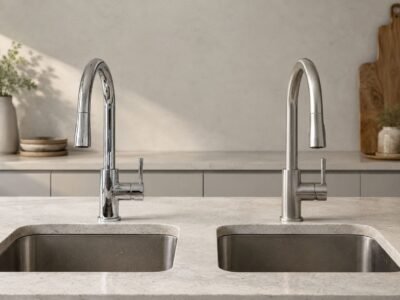
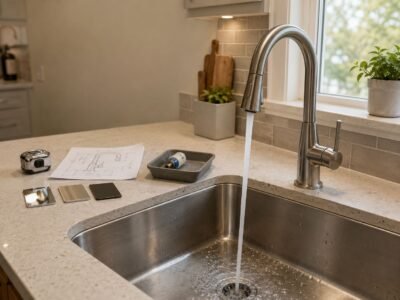
I’ve installed enough kitchen faucets to know the sprayer is the part people ignore until they live with it every day. A good kitchen faucet with a sprayer changes how fast I rinse produce, fill pots, and clean up after dinner. It also changes how I use water.
I don’t choose fixtures because they look good in a catalog. When comparing pull-down kitchen faucets, I focus on smooth hose movement, secure spray-head docking, and reliable control. These practical details matter more in daily use than appearance alone, and they are important features to consider when exploring A-TORNEIRA kitchen faucets.
Water efficiency still matters when choosing a kitchen faucet. Although residential kitchen faucets are not currently eligible for the EPA WaterSense label, the EPA recommends considering models rated at 1.8 GPM or less. Flow rate is useful for comparison, but spray control, splash reduction, and actual run time also affect everyday water use.
How a Kitchen Faucet with a Sprayer Transforms Your Daily Kitchen Experience
Rinsing Produce, Filling Pots, and Tackling Morning Messes with Ease
When I prep dinner, the sprayer earns its keep fastest on produce. The FDA recommends washing fruits and vegetables thoroughly under running water and advises against using soap, detergent, or commercial produce washes. A controllable spray can make it easier to rinse leafy greens, berries, and firm produce without directing excessive force at delicate ingredients.
In a deep single-bowl sink with a limited prep area, a fixed spout can make it awkward to rinse large batches of produce or clean the corners of the basin. A pull-down spray head improves reach and allows the user to direct water more precisely around the sink.
I like the sprayer most in the first fifteen minutes of the day, too. Coffee carafes, breakfast bowls, oatmeal pots, and sticky measuring cups move faster when I can aim the water instead of dragging a pan under a fixed stream.
How a Sprayer Can Speed Up Post-Meal Cleanup
After dinner, the sprayer saves more than a little time. Sheet pans, saucepans, and cutting boards clean faster when I can aim the water exactly where food is stuck. On models with a pause button, I can temporarily reduce or stop the flow while moving from one pot to another. When this feature is not available, an easy-to-operate lever handle provides similar control.

The big difference is reach. A fixed faucet makes me move the dish to the water. A sprayer lets me move the water to the dish. That matters when the sink is full, when the pan is awkward, or when I’m trying to keep greasy splatter from spreading across the whole prep area. That’s where the real convenience shows up.
Beyond Basic Rinsing: Pet Bowls, Plants, and Sink Accessories
Beyond the sink, the same control helps with pet bowls, watering plants, and rinsing coffee tools. I even like it for getting dried oatmeal out of a child cup or knocking soap residue off a dish rack.
The same control is useful for rinsing pet bowls, watering nearby plants, cleaning coffee tools, and removing soap residue from dish racks. It can also help loosen dried food from a child’s cup or rinse the corners and sides of the sink.
Choosing the Right Sprayer Type for Your Kitchen Layout
Once the day-to-day uses are clear, the next thing I look at is which faucet shape actually fits the kitchen.
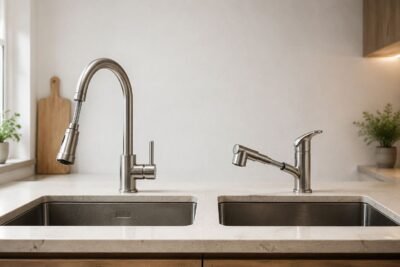
Pull-Down vs. Pull-Out vs. Side-Spray Kitchen Faucets
| Sprayer Type | Best For | Main Advantage | Potential Limitation |
|---|---|---|---|
| Pull-down faucet | Deep single-bowl sinks and large cookware | High clearance and natural downward spraying | May splash more in shallow sinks |
| Pull-out faucet | Compact kitchens and double-bowl sinks | Strong horizontal reach with a lower-profile spout | Usually provides less vertical clearance |
| Side-spray faucet | Traditional or existing multi-hole sink layouts | Separate sprayer preserves a classic faucet style | Requires an additional mounting hole and hose connection |

Pull-Down Faucets: The Best Fit for Deep Single-Bowl Sinks
Pull-down faucets are often a strong match for deep, single-bowl sinks. Their high-arc spouts provide clearance for stockpots and baking sheets, while the downward hose movement makes it easier to rinse the basin. However, a high-arc faucet may cause more splashing in a shallow sink, so the spout height should always be matched to the bowl depth. You can compare different dimensions and designs in our pull-down kitchen faucet collection.
This style earns its keep when the sink is the main work zone in the kitchen. If I cook a lot, wash big pans, or fill tall containers often, the extra height and movement make everyday use easier.
Pull-Out Faucets: Why They Excel in Compact and Double-Bowl Kitchens
Pull-out faucets are especially useful in compact kitchens, sinks installed beneath windows, and layouts with limited overhead clearance. Their lower-profile design keeps the faucet visually unobtrusive while still providing useful horizontal reach across the sink.
This type fits better when the kitchen is smaller and the faucet needs to stay visually quiet. You still get the benefit of a spray head, just without the extra bulk that can crowd a narrow room.
Side-Spray Faucets: When a Separate Sprayer Makes Sense
A separate side sprayer can be a practical choice when the sink deck already has an unused mounting hole or when the homeowner prefers a traditional multi-hole faucet design. Before buying, confirm the total number of faucet and accessory holes, their spacing, and whether a deck plate will be needed. A side-spray configuration is not automatically a simple two-hole installation.
Measuring Before You Buy: Spout Height, Hose Length, Magnetic Docking, and Deck Holes
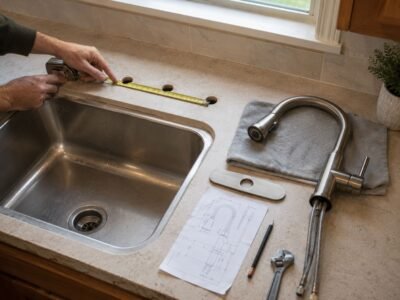
Before buying, measure the spout height and reach, faucet-hole diameter and spacing, deck thickness, and clearance behind the handle. Under the sink, make sure the hose and counterweight can move freely without striking the drainpipe, supply lines, garbage disposal, or stored items. For pull-down models, a secure magnetic or mechanical docking system helps keep the spray head seated properly.
I also picture the motion. Can the hose reach both bowls? Can I fill a pot without lifting it too high? Does the handle clear the backsplash? Those answers matter more than a glossy product photo. If you want a deeper walkthrough on matching fixtures to sink type, my guide on choosing the best kitchen faucet for your sink covers the full decision process.

Can a Kitchen Faucet with a Sprayer Help Save Water?
A sprayer is not automatically more water-efficient than a fixed-spout faucet. Actual savings depend on the faucet’s rated flow rate, spray pattern, pause function, and how it is used. Better control may reduce unnecessary run time, but the sprayer alone does not guarantee lower water consumption.
Flow rate matters, but it does not tell the whole story. When comparing models, look at the rated GPM, spray pattern, pause function, and how efficiently the faucet completes common rinsing and cleaning tasks.
How Better Flow Control May Reduce Water Waste
Directing water precisely can reduce repeated rinsing and unnecessary repositioning. Models with a pause function can also limit water use while cookware is being moved or tasks are being changed. In practice, water savings usually come from several small habits rather than one dramatic change.
Flow Restrictors and Aerators: The Simple Tech Behind the Savings
Flow regulators limit the maximum amount of water passing through the faucet, while aerators mix air into the stream to create a fuller feel and reduce splashing. The U.S. Department of Energy recommends considering efficient aerators or laminar-flow devices when reducing faucet water use.
If the sprayer helps me stop the water between tasks, the difference shows up over weeks of dishwashing, produce rinsing, and pot filling.
What Determines Your Annual Water Savings
Annual savings depend on the old and new faucet flow rates, daily run time, hot-water use, local utility rates, and household habits. To estimate potential savings, compare the rated GPM of the two faucets and multiply the difference by the average number of minutes the faucet runs each day. Avoid promising a fixed dollar amount unless the assumptions are clearly shown.
Smart Features on a Kitchen Faucet with a Sprayer That Are Actually Worth the Investment
The next question is simple: do the extra features actually make daily use easier?
Kitchen Faucet Features: Useful Upgrade or Unnecessary Extra?
| Feature | Best For | Main Benefit |
|---|---|---|
| Pause button | Frequent rinsing and multitasking | Temporarily reduces or stops the flow at the spray head |
| Magnetic docking | Pull-down faucet users | Helps keep the spray head securely seated |
| Touchless activation | Busy kitchens and users with limited hand mobility | Starts and stops the water without touching the handle |
| Temperature memory | Households that frequently use similar temperature settings | Maintains or restores a previous temperature setting |
| Integrated filtration | Homes wanting filtered and regular water from one fixture | Reduces the need for a separate filtered-water tap |
| Multiple spray modes | Produce rinsing, sink cleaning, and cookware cleanup | Adjusts the water pattern for different kitchen tasks |

Touchless and Motion-Sensor Faucets: How They Work and When They Justify the Cost
Touchless faucets are not for every kitchen. In a busy home, they make sense when hands are messy, I’m carrying a pan, or the sink gets used by several people in a hurry. The upside is simple: I can start and stop the water without twisting a handle with flour-covered fingers. A complete guide to automatic faucet control walks through how sensor tech works and whether the premium is worth the daily convenience.
Easy-to-operate lever handles and hands-free activation may be helpful for users with limited grip strength. In an accessibility-focused kitchen, intuitive sensor placement, manual override, and simple temperature control may matter more than decorative finishes.
Temperature Memory and Digital Controls: Genuine Convenience or Expensive Gimmick?
Temperature memory can be useful when a faucet reliably returns to its previous setting, but not every electronic faucet supports programmable temperature presets. Check how the feature works, whether a manual override is available, and whether the temperature limit can be adjusted safely.
Digital controls can help in a kitchen where multiple people use the sink for food prep, but I always ask whether the extra feature solves an actual problem or just adds another thing to troubleshoot later.
Integrated Water Filtration: Purified Water and Sprayer Convenience in One Fixture
I like filtered-water integration when the household already wants a cleaner water setup and doesn’t want a second tap crowding the counter. It keeps the sink tidy and gives you a single place to rinse produce or fill a glass.
The key is whether the filter is easy to change and whether the faucet still feels balanced when you switch modes.
Smart Buying Decisions: Common Mistakes and the True Cost of Ownership
This is the section where most mistakes happen. People fall in love with the look, then discover the hose bangs the cabinet, the handle feels awkward, or the sprayer doesn’t dock cleanly.
Sink Compatibility, Deck Holes, and Hose Length: What First-Time Buyers Get Wrong
I always check the faucet-hole diameter and spacing, the number of available deck holes, the maximum mounting thickness, and the usable hose reach. A deck plate may cover unused holes, but it cannot correct incompatible hole spacing or insufficient mounting clearance.
I also check the clearance behind the faucet. A pretty design can still be wrong if the handle hits a backsplash or if the hose rubs the underside of the cabinet.
Style vs. Everyday Functionality: How to Make the Right Trade-Off
Style matters, but only after the faucet works. I want a finish that fits the room, but I care more about how the spray head docks, whether the handle feels smooth, and how easy the surface is to wipe down after a messy dinner. Brushed nickel, chrome, and matte black all have their place, but the one I pick has to fit the way the kitchen is actually used.
A decorative faucet that becomes frustrating in daily use is not a good purchase. A simpler model that operates reliably and is easy to maintain will often remain satisfactory for longer.
Warranty, Replacement Parts, and Common Wear Points
Over time, the spray hose, docking mechanism, spray head, seals, and ceramic-disc cartridge are the components most likely to show wear. Warranty length alone does not prove quality, so check which parts are covered, whether finish damage and labor are excluded, and how easily replacement components can be obtained.
If the faucet leaks at a hose connection, inspect the quick-connect fitting, O-rings, and hose before replacing the entire fixture. A loose spray head may only require a counterweight adjustment or a replacement docking clip or magnet. If the handle drips, becomes stiff, or provides inconsistent flow control, the ceramic-disc cartridge is usually the first replaceable component to check.
That’s why I care about the feel of a faucet long before I care about the box it came in. A good kitchen faucet with a sprayer should make daily work easier, not just prettier. When it fits the layout, controls water well, and feels good in real use, you notice it every single day. Browsing our full kitchen sink faucet collection is a good way to see how different styles hold up side by side before you commit.