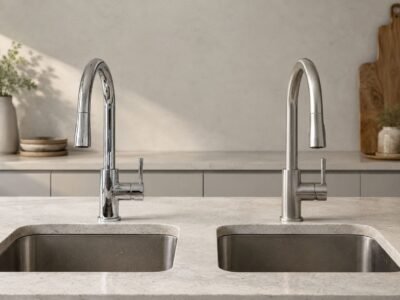
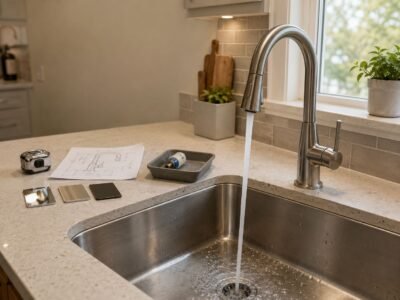
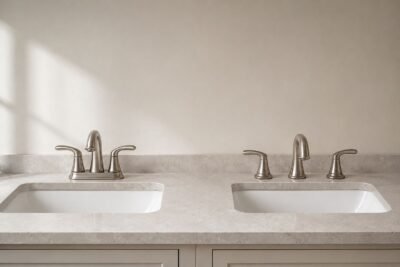
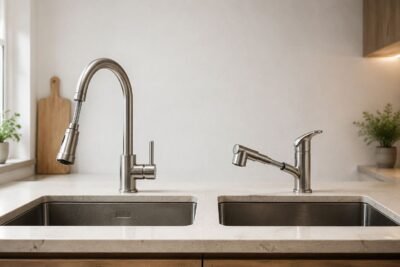
A kitchen faucet can look perfect online and still be wrong for your sink. I have seen it many times in my 10 years in the faucet industry: a buyer opens the box, loves the finish, lifts it toward the sink… and then notices the handle hits the backsplash, the spout is too short, or the faucet needs a hole the countertop does not have.
That is frustrating. It is also avoidable.
Here is how I choose a kitchen faucet when I want it to work well, look right, and last longer.
Check Sink Compatibility and Installation Requirements
Before style, finish, or smart features, I always check the sink. A faucet is like a shoe. Even a beautiful one is useless if it does not fit.
Know Your Sink’s Mounting Hole Configuration

Look at the holes on your sink or countertop. Most kitchen sinks have 1, 2, 3, or 4 holes.
A single-hole faucet is common in modern kitchens. It usually has one handle and a clean look. A 3-hole setup may fit a two-handle faucet, a side sprayer, or a modern single-hole faucet with an escutcheon plate. That small cover plate can hide the extra holes and make the installation look clean.
Here is a simple guide:
| Sink Hole Setup | Common Faucet Choice | What to Check |
|---|---|---|
| 1 hole | Single-handle faucet | Best for clean modern designs |
| 2 holes | Faucet + accessory | Check sprayer or soap dispenser fit |
| 3 holes | Two-handle faucet or single-hole faucet with escutcheon plate | Measure hole spacing and plate coverage |
| 4 holes | Faucet + sprayer + dispenser | Plan each part before buying |
Never guess the hole count. Open the cabinet, look from below, and take a quick photo. It saves headaches.
If your old faucet is still installed and you are planning a DIY upgrade, my step-by-step guide on kitchen faucet installation can help you understand the tools, mounting steps, and common mistakes before you remove anything.
Balance Spout Height, Total Height, and Spout Reach
These three measurements confuse many buyers.
Total height is the full height of the faucet from the base to the highest point.
Spout height is the space from the base to where water comes out.
Spout reach is how far the water outlet extends into the sink.
For a deep sink, a taller spout can feel great. You can wash a stockpot without fighting the faucet. But in a shallow sink, that same tall spout may splash water everywhere.
Spout reach matters even more. I like the water stream to land near the drain area, not too close to the back wall or the front edge. If the reach is too short, you will keep bumping dishes against the sink. Too long, and water may splash toward you.

Check Cabinet Clearance and Countertop Space
Picture this: you are rinsing a heavy pan after dinner. Steam rises. Your hands are wet. You pull the spray head down, but the faucet body sits too close to the window sill. The handle cannot move fully. Annoying, right?
That is why I check the space behind and above the sink.
If you have a window, shelf, or cabinet above the sink, measure the vertical clearance. If your backsplash clearance is incredibly tight, specifically look for faucets equipped with a forward-only rotation handle, often called a 90-degree zero-back-clearance cartridge, so the lever never hits the wall.
Consider Ergonomics, Sink Depth, and ADA-Friendly Features
A faucet should be easy to use when your hands are wet, greasy, or full.
Lever handles are usually easier than small knobs. The U.S. Access Board says accessible operable parts should work with one hand, without tight grasping, pinching, wrist twisting, or more than 5 pounds of force. That is a good rule even if you are not designing an ADA kitchen. Easy is always better.
For large sinks, choose a faucet with good swivel range and a comfortable spray head. For compact sinks, avoid oversized high-arc faucets unless the basin is deep enough to control splash.
Choose the Right Faucet Type and Design Style
This is the part most people enjoy. It is also where many people get lost.
The best faucet style is not just about looks. It should match how you cook, clean, and move around the sink.
At A-TORNEIRA, I often think about this balance when reviewing faucet designs: beauty gets attention, but daily comfort earns trust.
Single-Handle vs. Double-Handle Kitchen Faucets
A single-handle faucet is my usual choice for busy kitchens. You can control water temperature and flow with one hand. If you are holding a bowl or have flour on your fingers, that matters.
For this reason, many homeowners start their search with single handle kitchen faucets, especially when they want a cleaner countertop and faster daily control.
Single-handle faucets also fit modern kitchens well. They look simple and need less space.
Double-handle faucets give more separate control over hot and cold water. Some people also love their classic look. They fit farmhouse, vintage, and traditional kitchens nicely.
The tradeoff? Double-handle faucets usually need more installation space. They also have more parts, which can mean more places to maintain over time.
My quick advice: choose single-handle for speed and simplicity. Choose double-handle if style and precise temperature control matter more to you.
If you are still comparing handle types, I suggest reading my deeper guide on single-handle vs. double-handle faucet options. It explains the daily-use differences, the pros and cons, and which setup fits different kitchen or bathroom layouts best.
Pull-Down vs. Pull-Out Kitchen Faucets
This is one of the biggest choices.
A pull-down faucet usually has a tall arc and a spray head that pulls down into the sink. I like it for deep sinks and people who cook often. It feels natural when rinsing vegetables, washing pans, or cleaning the sink walls.
A pull-out faucet has a spray head that pulls toward you. It often has a lower profile, so it works well under cabinets or in smaller kitchens. The hose may reach farther across the sink area.
Here is the easy way to choose:
| Faucet Type | Best For | Main Benefit |
|---|---|---|
| Pull-down | Deep sinks, large cookware | Strong control inside the basin |
| Pull-out | Small sinks, low cabinets | Longer reach and lower height |
| Fixed spout | Simple kitchens | Fewer moving parts |
| Side sprayer | Traditional setups | Separate spray function |
If you wash large pots often, go pull-down. If you need reach more than height, go pull-out.
For deep sinks, large cookware, and busy meal prep, pull-down kitchen faucets are usually the first style I recommend because the spray head moves naturally into the basin.

High-Arc Gooseneck vs. Low-Arc Faucets
A high-arc gooseneck faucet makes a kitchen feel open and professional. It gives more room under the spout, which is helpful for big pots, baking trays, and tall pitchers.
But bigger is not always better!
If your sink is shallow, a high-arc faucet may create more splash. If your kitchen has a low window or wall shelf, it may look crowded.
A low-arc faucet feels calmer. It works well in compact kitchens and under cabinets. It also keeps the sightline cleaner, which matters in an open kitchen where the sink faces the living room.
For double-bowl sinks, a high-arc gooseneck with a 360-degree swivel is almost mandatory. A low-arc profile can strike the center divider when you move from one basin to the other. That little bump gets old fast.
Bridge, Commercial-Style, and Articulating Faucets
Bridge faucets have a classic shape, with hot and cold lines connected above the sink. They look beautiful in farmhouse or vintage kitchens. They are more about character than minimalism.
Commercial-style faucets have a spring coil or exposed hose look. They feel bold and practical. If you cook a lot, this style can be very useful. Just make sure the height fits your space.
Articulating faucets have jointed arms that move in different directions. They can look striking, almost like a tool from a chef’s kitchen. They are great for flexibility, but they need room to move.
My rule is simple: do not choose a dramatic faucet unless your sink area can support it. A bold faucet in a tiny sink can feel like a spotlight in a closet.
Match the Faucet Style with Your Kitchen Design
A faucet should feel connected to the rest of the kitchen.
For modern kitchens, I like clean lines, single handles, and finishes like matte black, brushed nickel, or stainless steel. For warm traditional kitchens, bridge faucets or softer curved shapes work well. For industrial kitchens, commercial-style faucets make sense.
Also look at your cabinet pulls, sink color, lighting, and appliances. They do not all need to match exactly, but they should speak the same design language.
Compare Features, Functionality, and Internal Quality
Features are useful only when they solve a real problem. I care more about smooth daily use than a long list of fancy words.
Spray Modes, Swivel Range, and Water Flow Control
Most good kitchen faucets offer stream and spray modes. Stream is for filling pots. Spray is for rinsing plates and vegetables.
A pause button can help when moving the spray head outside the sink, but make sure it feels solid. Cheap buttons often feel loose after months of use.
Swivel range is also important. A 360-degree swivel is useful for large or double-bowl sinks. For small sinks, 180 degrees may be enough.
For water flow, many current residential kitchen faucet specs now target a maximum flow rate of 1.8 GPM at 60 psi. Stricter regions, such as California under CEC efficiency rules, may require 1.5 GPM models to save water while keeping daily performance comfortable. Older federal references still mention 2.2 GPM, so always check the local market requirement before buying or importing.
Why Ceramic Disc Valves Matter for Durability
The valve is the heart of the faucet. You do not see it, but you feel it every day.
I prefer ceramic disc cartridges because they are smooth, durable, and better at resisting drips than older washer-style designs. When a handle turns softly and stops cleanly, the valve quality is often part of the reason.
If a faucet looks good but uses a weak cartridge, I would pass. A shiny finish cannot fix a dripping valve.
Touchless, Motion-Activated, and Smart Faucet Features
Touchless faucets are helpful when your hands are dirty from raw meat, dough, or garden vegetables. Wave, rinse, done. It feels small until you use it during a messy dinner prep.
Battery-powered models are easier to install. AC-powered models can reduce battery changes. I also like models with a manual handle, because sensors should help you, not trap you.
Choose smart features if you will actually use them. Otherwise, a reliable manual faucet may be the better buy.
Ease of Cleaning, Maintenance, and Mineral Build-Up Prevention
Hard water leaves white mineral spots. If you live in a hard-water area, choose a faucet with easy-clean rubber spray nozzles. You can rub off buildup with your fingers.
Avoid harsh cleaners unless the manufacturer allows them. Some strong chemicals can damage finishes over time.
Select Durable Materials, Finishes, and Long-Term Value
A faucet touches drinking water, food, and your hands every day. So material quality matters.
Common Faucet Materials: Brass, Stainless Steel, and Zinc Alloy
Solid brass is a trusted choice for durability. Stainless steel is also strong and clean-looking. Zinc alloy is often used in lower-cost parts, but it may not offer the same long-term strength.
For drinking water safety, look for dual compliance with NSF/ANSI 61 and NSF/ANSI 372. NSF/ANSI 61 focuses on health effects from materials that contact drinking water, while NSF/ANSI 372 verifies lead-free compliance for products that convey or dispense water for drinking or cooking.

Chrome, Brushed Nickel, Matte Black, and Stainless Steel Finishes
Chrome is bright, easy to find, and usually affordable. It does show water spots.
Brushed nickel hides fingerprints well and fits many kitchens. Matte black looks modern and bold, but low-quality black finishes may scratch more easily. Stainless steel has a clean, practical look and works well with many sinks.
| Finish | Best For | Watch Out For |
|---|---|---|
| Chrome | Bright, budget-friendly kitchens | Water spots |
| Brushed nickel | Family kitchens | Color tone may vary |
| Matte black | Modern kitchens | Scratches on cheap finishes |
| Stainless steel | Clean practical designs | Quality differences |
Electroplating vs. PVD Finishes: Which Lasts Longer?
Electroplating is common and cost-effective. A good electroplated finish can perform well with proper care.
PVD finishes are often used for higher durability. They can resist wear, fading, and corrosion better when made well. They also tend to cost more.
When I compare finishes, I do not only ask, “What color is it?” I ask, “How was that finish made?”
Warranty, Certifications, and Final Buying Checklist
Before buying, I run through this checklist:
- Does it fit the sink hole setup?
- Is an escutcheon plate needed for extra holes?
- Is the spout reach right for the drain?
- Will the handle clear the wall or backsplash?
- Does the faucet style match the kitchen?
- Is the valve cartridge reliable?
- Is the finish easy to maintain?
- Are the materials and certifications clearly stated?
- Is the warranty easy to understand?
A kitchen faucet is used many times a day. Choose one that feels right in your hand, fits your sink, and matches the way you live. That is the kind of faucet I would recommend, and it is the standard I like to see from A-TORNEIRA products too.