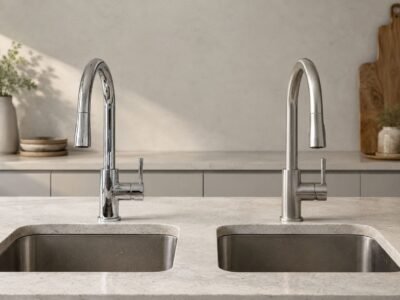
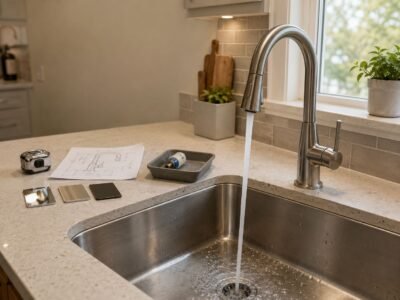
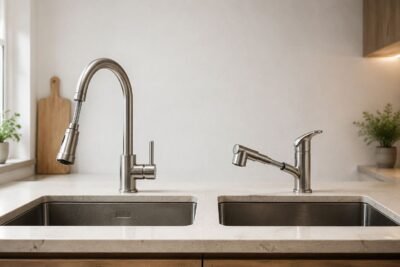
If I’m helping someone choose the best kitchen sinks and faucets, I start with the same question every time: what does the kitchen need to do all day? A pretty sink and a shiny faucet can still feel wrong if the bowl is too shallow, the spray reach is short, or the finish fights the rest of the room. The best setup is the one that makes washing, rinsing, filling, and cleanup feel easy.
I’ve seen kitchens look great on day one and turn annoying by week two. A properly sized sink with the right faucet reach can reduce splash and make cleanup easier. A wider faucet arc can make pan washing less awkward. And if the sink and faucet don’t match in size or hole layout, the install becomes a headache fast. That’s why I treat them as a pair, not two separate purchases.
According to Consumer Reports, sink performance depends on more than thickness alone; sound-dampening pads and overall construction matter a lot. That’s one reason I look at the full build, not just the surface finish.
Best Kitchen Sinks and Faucets: Materials and Types
Stainless Steel, Granite Composite, and Fireclay Kitchen Sinks
Stainless steel is still the safest choice for most kitchens. It handles heat well, it looks clean, and it fits almost any style. I like it for busy homes because it forgives a lot of daily abuse. Granite composite feels heavier and more solid, while fireclay gives that classic farmhouse look with a strong visual presence.
Here’s the part people skip: material is only half the story. A thin stainless sink with no padding can sound hollow and cheap. Granite composite feels solid and premium, but its weight, cutout accuracy, mounting support, and cleaning requirements should be checked before installation. Fireclay looks beautiful, but it is not my pick if you throw cookware around or want a very lightweight installation.
I worked on a 2024 kitchen refresh in Austin where the owner wanted a deep, dark sink for meal prep. We compared a stainless bowl and a composite bowl side by side. The composite won on feel, but the stainless model made more sense because the kitchen saw heavy use, the water pressure was high, and the family wanted low-maintenance cleanup.
| Sink Material | Best For | Main Advantages | Recommended Faucet Match |
|---|---|---|---|
| Stainless Steel | Busy family kitchens, rental homes, and everyday cooking spaces | Durable, heat-resistant, easy to clean, and suitable for most kitchen styles | Pull-down faucet with enough reach and a matching stainless or brushed nickel finish |
| Granite Composite | Modern kitchens, darker color schemes, and homeowners who want a solid, premium feel | Heavy, quiet, scratch-resistant, and available in bold color options | Modern pull-down or touchless faucet in matte black, brushed nickel, or a coordinated finish |
| Fireclay | Farmhouse kitchens, traditional designs, and kitchens where visual impact matters | Classic look, strong surface, smooth finish, and excellent design presence | High-arc faucet or bridge-style faucet with enough reach for the deeper basin |
Undermount, Drop-In, and Farmhouse Installation Styles
Undermount sinks are my favorite when the countertop supports them. They make wipe-down easier because crumbs and water go straight into the bowl. Drop-in sinks are simpler and cheaper to install, so I still use them in remodels where budget or countertop material limits the options. Farmhouse sinks bring character and a bigger basin, but they need the right cabinet depth and a faucet with enough reach.
I always tell clients to check the counter edge, cabinet depth, and sink cutout before they fall in love with a style. A farmhouse sink can look perfect online and still be wrong for a small kitchen. An undermount can feel ideal, but not every countertop material likes that kind of edge detail.
A 2023 condo project in Miami taught me that lesson again. The owner wanted the visual weight of a farmhouse sink, but the cabinet was shallow and the layout was tight. We switched to an undermount single bowl, and the room felt larger right away.
Single Bowl, Double Bowl, and Workstation Configurations
Single bowl sinks are the easiest to live with if you cook big meals, wash sheet pans, or soak large pots. Double bowl sinks help if you want to rinse on one side and soak on the other, but they divide the usable space fast. Workstation sinks add ledges, accessories, and prep flexibility, which is great if the kitchen does a lot of real work.
My rule is simple: choose the layout that matches your largest everyday task. If you rinse baking sheets, skip the cramped double bowl. If you prep vegetables beside the sink, a workstation can save counter space. If you mainly want something durable and flexible, a simple single bowl usually wins.
Once the sink shape is set, the faucet has to make that layout work harder, not fight it. That’s when I start looking at kitchen sink faucets to see which styles match the basin I’ve picked.

Best Kitchen Faucet Styles and Features
Pull-Down, Pull-Out, and Commercial-Style Kitchen Faucets
Pull-down faucets are the easiest all-around choice for most kitchens. The spray head reaches into the bowl well, and the hose usually feels natural in daily use. Pull-out models are useful in smaller kitchens where the spout height needs to stay lower. Commercial-style faucets can be great for busy cooking spaces, but they only make sense if the sink and counter area are large enough to support the look.
I prefer to think about faucet motion before finish. If the hose feels stiff or the spray head bangs into the sink wall, the faucet will annoy you every single day. A smoother hose and a better counterweight make more difference than people expect. If you want a closer look at what each spray style offers, our pull-down kitchen faucet guide breaks down the pros and cons in detail.
In one 2025 rental kitchen in Phoenix, I swapped a fixed spout for a pull-down faucet because the tenant cooked almost every night. The change did not make the kitchen fancier. It just made cleanup faster, which is what mattered.
Touch, Touchless, and Smart Faucet Technology
Touch faucets are handy when your hands are messy. Touchless models are even better when you want to reduce contact, especially in kitchens that see heavy prep work. Smart features can be useful, but I’m cautious with anything that depends too much on batteries, sensors, or app settings.
For kitchen faucets, I focus on rated flow rate, spray performance, and local efficiency standards rather than assuming every model carries a WaterSense label. That’s the balance I want in a kitchen faucet. If a feature saves water but gets in the way, most people stop using it.
I like touch and touchless options when they solve a real problem. If someone cooks a lot, handles raw food, or wants less fingerprint cleanup, the upgrade can feel worth it. But if the faucet gets used only a few times a day, a simple manual model may be the smarter buy.
That’s also when I often reach for A-TORNEIRA — when I want a faucet that feels straightforward for the homeowner and easy to explain during installation.
Spout Height, Reach, and Finish Selection
Spout height and reach matter more than color. A tall arc can look beautiful, but it may splash if the sink is shallow. A short spout can look safe, but it may not reach the center of a large basin. I match the faucet to the sink depth, bowl width, and the biggest pot that gets washed there.
Finish selection is about the room, not just the faucet. Stainless, matte black, brushed nickel, and polished chrome all behave differently in real light. If the kitchen already has strong cabinet hardware or a busy backsplash, I usually choose a quieter faucet finish so the room does not feel crowded. I’ve written more about how different coatings hold up over time in my guide on best faucet finish options — it’s worth a read before locking in a color.
If you love a bold finish, let the sink support it without competing. That balance usually ages better.
Matching the Best Kitchen Sinks and Faucets
How Sink Configuration Affects Faucet Selection
This is the part that saves people money. A big sink needs a faucet with enough reach to hit the drain area and rinse corners. A workstation sink may need a higher spout or a more flexible hose. A farmhouse sink can swallow a short faucet visually, so the proportions have to be right.
Think about how you use the sink before you lock in faucet style and reach. That advice still holds up on real jobs, because the wrong reach shows up every single day. My own guide to choosing the best kitchen faucet covers the same idea with more detail on how bowl depth and faucet reach interact.
I always check how the faucet spray lands inside the basin. If the stream hits too close to the front edge, water splashes back. If it lands too far rearward, rinsing becomes awkward. The goal is simple: the sink should accept the faucet without forcing either one to compromise.
Coordinating Mounting Holes, Finishes, and Styles
Mounting holes are a bigger deal than most people realize. Some sinks are built for one-hole faucets. Others accept three holes, and some need a deck plate or accessory cover. If you ignore that detail, you can end up with extra holes showing or an install that looks patched together.
I also like to match the visual language of the sink and faucet. A square-edged sink usually pairs well with a clean, modern faucet. A rounded fireclay bowl often looks better with a softer profile. That does not mean every piece has to match exactly. It just means the room should feel intentional.
When I need fixtures that merge clean design with fuss-free install work, A-TORNEIRA is often what I spec. It fits best when I want the kitchen to feel coordinated without making the hardware the star of the room.
Clearance, Reach, and Installation Compatibility
Before I sign off on a sink-and-faucet combo, I check clearance over the window sill, backsplash, and cabinet doors. I also check reach over the basin and the space needed for soap dispensers, filtration taps, or side sprays. Small clearance mistakes turn into daily irritation.
A good installation also needs room for service. If a faucet cartridge, sprayer hose, or sink clip becomes hard to reach later, the job will be annoying even if it looks great on launch day. I like designs that balance beauty with basic service access.
Once those details line up, the whole kitchen feels calmer. Nothing fights the user, and that’s the real win.

Cost, Durability, and Smart Investment Decisions
Price Tiers for Quality Sinks and Faucets
I don’t tell people to buy the most expensive option. I tell them to buy the best option for the way they cook and clean. A solid mid-range stainless sink with good padding can outperform a fancy sink that looks impressive but does not suit the kitchen. The same goes for faucets. A simple, well-made pull-down can beat a high-tech model that adds maintenance without adding comfort.
Budget matters, but hidden costs matter too. Extra plumbing parts, a deck plate, a different sink cutout, or countertop work can push the total higher than expected. When I price a project, I include the install, the accessory pieces, and the time needed to make the layout work cleanly.
Material Longevity and Maintenance Requirements
Durability is not just about how long something lasts. It is about how easy it is to keep looking good. Stainless steel is usually easy to live with. Granite composite resists a lot of wear. Fireclay is durable and visually strong, but it is less forgiving than stainless steel when heavy cookware is dropped against the surface or edges.
Maintenance is where many buyers change their minds after the install. A sink that hides water spots may be better for a busy family than one that needs constant wiping. A faucet with fewer seams may stay cleaner than a more decorative one. That is why I ask clients to imagine Sunday night cleanup, not just showroom day.
Where to Invest and Where to Save
If the kitchen gets heavy use, I spend money on the sink depth, faucet reach, and hose quality first. Those three things affect the daily experience more than most decorative choices. I save on anything that does not change the workflow.
If the kitchen is more about light use and presentation, I shift the budget toward finish and shape. Either way, I want the hardware to feel stable, easy to clean, and easy to use. That is the difference between a kitchen that looks finished and one that actually works.

FAQ
What is the best material for a kitchen sink?
Stainless steel is the safest all-around pick. It is versatile, durable, and easy to match with almost any kitchen style.
How do I choose the right faucet for my kitchen sink?
Match the faucet to the sink depth, bowl width, and daily tasks. If you wash big pans, choose enough reach and a comfortable spray hose.
Are touchless kitchen faucets worth the extra cost?
They can be, especially if you cook often or want less hand contact. If your kitchen use is light, a simpler manual faucet may be the smarter buy.