If you’re shopping for the best touchless kitchen faucet, start with one question: how do you actually use your sink every day? Buyers sometimes pick a fancy model for a spotless showroom kitchen, then regret it because of hyper-sensitive sensors, low-quality solenoid valves, or bulky control boxes that crowd under-sink storage.
A touchless faucet can make a kitchen cleaner and easier to live with. It helps when your hands are full, when you’re handling raw chicken, or when you just want fewer fingerprints around the sink. EPA WaterSense Homes technical guidance recommends specifying and installing kitchen faucets with a flow rate between 1.5 and 1.8 gpm, which gives buyers a useful benchmark for balancing water savings and everyday performance.
According to CDC food safety guidance, raw meat and poultry can spread germs to ready-to-eat food unless you keep them separate and clean surfaces carefully. This is where a hands-free kitchen faucet becomes useful: it reduces handle contact when your hands are messy and helps keep the sink area easier to clean.
The trick is choosing the right type for your setup. Many buyers focus only on looks, then regret the install, the power source, or the sensor behavior.
Best Touchless Kitchen Faucets to Consider First
| Category | Best For | Typical Features | Watch Out For |
|---|---|---|---|
| Budget Touchless Faucet | Light home use | Basic motion sensor, pull-down sprayer | Sensor accuracy, short warranty |
| Mid-Range Touchless Faucet | Most family kitchens | Better valve, finish, sensor response | Check control box size |
| Premium Smart Faucet | Smart homes | Voice control, app control, measured dispensing | Higher cost, power dependency |
| Commercial Touchless Faucet | Hotels and food service | Durable body, serviceable parts | Certification and parts availability |
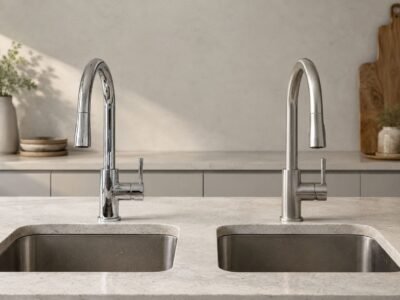
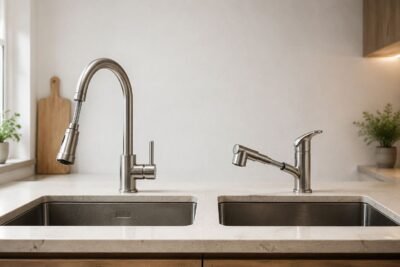
If you want the simplest way to narrow the field, I divide touchless kitchen faucets into three buckets: budget-friendly, mid-range, and premium smart models. If you want a broader starting point, browsing our hands-free sink faucet collection is a practical first step before diving into specs.

Entry-Level Picks Under $150: Solid Performance Without the Premium Price
At this price level, you’re usually paying for basic motion-activated sensing, a decent pull-down sprayer, and a finish that looks good enough for a modern kitchen. In this tier, don’t judge by appearance alone. Check whether the valve, cartridge, sensor module, and battery box are easy to service, because those parts usually decide whether a budget touchless faucet feels reliable after a few months.
The catch is that the sensor usually has fewer adjustment options, so placement matters more.
If your sink sees light daily use, this tier can make sense. It’s still worth checking the under-sink layout first. A cheap faucet becomes expensive if the control box is awkward, the hose is short, or the battery pack blocks your filter system.
Mid-Range Workhorses ($150-$350): The Sweet Spot for Most Kitchens
This is where most buyers should look first. You usually get better build quality, smoother spray modes, and more reliable sensor response. At this price, the faucet feels practical instead of gimmicky.
Premium and Smart Models: Voice Control, App Integration, and Advanced Sensors
Premium models are for people who want more than a sensor-activated faucet. They often add voice control, app features, or more advanced sensor logic. That can be useful, but only if the rest of your kitchen already supports that level of complexity. Before paying for smart features, check whether the faucet still works manually, whether the app is required for basic use, and whether the power system has a battery backup.
I’d only go premium if you genuinely want the extra features. If not, the mid-range zone usually gives better value.
How to Choose the Best Touchless Kitchen Faucet
Here’s the thing: the sensor is only one part of the decision. The power source, flow rate, finish, and compatibility matter just as much. For a more systematic approach, this kitchen faucet selection guide walks through the decision process step by step.
WaterSense guidance places efficient kitchen faucets at roughly 1.5–1.8 gpm for performance and savings. That doesn’t mean higher flow is always bad, but it gives you a sensible benchmark.
Infrared Motion, Wave Sensors, and Touch-Activated Controls

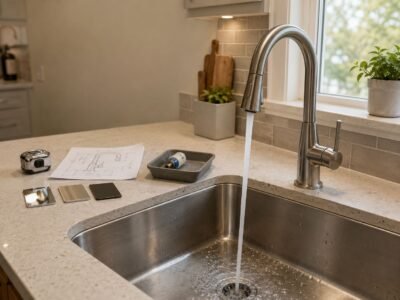
Infrared motion sensors detect movement in a defined zone. They’re common and can work well, but they can also trigger when you don’t expect it if the sensing range is too broad.
Wave-style sensors tend to feel more forgiving in real use. Capacitive touch is a different category altogether—it requires a physical tap on the spout or body. While convenient, it is not truly touchless. If minimizing cross-contamination is your top priority, stick to Infrared or Wave Radar. If you want a hands-free kitchen faucet for hygiene, that distinction matters. For a hands-free setup that also gives you full sink reach, a pull-down kitchen faucet is a strong pairing.
Battery, AC, or Hybrid: Which Power System Fits Your Kitchen Setup
Battery power is the easiest to install. It also means you’ll need to think about replacement intervals and warning lights. Many battery-powered touchless faucets last around one to two years under normal household use, but the real interval depends on battery type, sensor design, and how often the faucet is activated.
AC power provides maintenance-free operation but requires an unswitched GFCI outlet beneath the sink. Hybrid systems give you a backup path if the power situation changes. In a busy kitchen, that little bit of redundancy is worth a lot.
Flow Rate, Finish Durability, and Installation Compatibility
Flow rate affects how the faucet feels, but finish durability affects how it looks after six months. If you cook a lot, fingerprints and mineral spots show up fast.
Compatibility is the part people skip. Check whether your sink is single-hole or three-hole. Also look at hose routing, battery box space, and whether the control unit will crowd the cabinet. Getting the sink configuration right before installation saves a lot of headaches later.
Why a Touchless Kitchen Faucet Is Worth It
I like touchless faucets for one reason above all: they remove small annoyances all day long. That sounds minor, until you notice how often you touch the handle with messy hands.
CDC food safety guidance for raw poultry highlights how easily germs can spread in a busy kitchen. A touchless faucet doesn’t solve every food-safety problem, but it helps reduce one more contact point.
Hygiene That Pays Off: Reducing Cross-Contamination in a Busy Kitchen
When your hands are coated with dough, sauce, or raw meat residue, the handle is one more surface to clean. A hands-free, automatic kitchen faucet cuts down on that touch cycle.
That’s especially useful in family kitchens and hospitality settings. Sink areas often stay cleaner because users no longer need to grab the handle repeatedly during food prep.
Water Savings: How Auto-Shutoff Helps Reduce Waste
Touchless faucets often shut off faster than people do. That can save water in real life, especially in kitchens where the faucet gets left running while someone reaches for a towel or turns around for a pan.
The main point is simple: an efficient flow rate plus automatic shutoff can reduce waste without making the faucet feel weak. If water bills are a concern, this water-efficient faucet guide breaks down the savings room by room.
Everyday Convenience: Multitasking, Accessibility, and a Cleaner Sink Area
This is the part people notice after installation. You can rinse produce with one hand while holding a bowl with the other. You can turn water on with an elbow when your hands are dirty.
For older users or anyone with limited hand strength, that convenience is not a luxury. It makes the sink easier to live with.
Installation and Maintenance: What to Expect After You Buy

The complexity of installing a touchless faucet rarely lies in the fixture itself—it is almost always found in the cabinet infrastructure below.
DIY Installation Step-by-Step: Single-Hole vs. Three-Hole Sink Compatibility
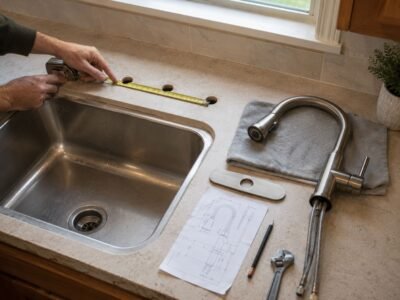
Start by checking your sink deck. A single-hole install is straightforward. A three-hole sink may need a deck plate, and that changes both the look and the installation time.
Plan the hose path before you tighten anything. If the control box or battery pack sits in the wrong place, you’ll hate maintenance later.
Common Installation Pitfalls That Lead to Leaks or Voided Warranties
The big mistakes are simple: overtightening fittings, pinching supply lines, and ignoring the manufacturer’s placement instructions for the sensor or control box. Another common mistake is placing the hose weight where it hits the shutoff valve, filter housing, or cabinet wall. That can make the pull-down sprayer retract poorly.
If the sink cabinet is already crowded, it’s worth slowing down and measuring twice. A neat install today saves a repair call later.
Long-Term Care: Sensor Cleaning, Battery Replacement, and Troubleshooting
Keep the sensor area clean. Grease, soap film, and hard-water buildup can affect response.
If the faucet starts acting oddly, check the batteries first, then inspect the sensor surface, then look for hose kinks or loose connectors. Most problems are fixable without replacing the whole unit.
Touchless Faucets for Hotels and Commercial Kitchens

In hotels, cafés, and prep kitchens, the value of a touchless faucet is not just hygiene. It’s also speed, consistency, and fewer hands on the fixture. For commercial buyers, the faucet itself is only part of the cost. Replacement parts, service access, downtime, and staff training often matter more than the initial unit price.
Cost vs. ROI: Why Commercial Buyers Are Switching to Touchless
Commercial buyers think in terms of uptime and labor flow. If a touchless faucet reduces cleanup time or keeps a sink station moving, it pays for itself faster than a decorative upgrade would.
That’s why it helps to treat this category as an operational tool, not just a style choice.
Built for Heavy Use: Certifications, Materials, and What to Verify Before Ordering
For heavier use, it’s worth paying attention to valve quality, finish durability, and whether replacement parts are easy to source.
If a product looks great but the service path is unclear, that’s a warning sign. On busy jobs, it’s usually smarter to pick gear that’s simple to maintain and easy to explain to a staff member.
Bulk Purchasing Checklist for Hospitality and Food Service Operations
Before ordering multiple units, verify the sink cutout, power plan, replacement part availability, and who will service the faucet later.
It’s often useful to test one unit before buying in quantity. That single sample can reveal cabinet-space problems that a spec sheet never shows.
FAQ
Q: Are touchless kitchen faucets worth the extra money?
A: Yes — if you cook often. They cut down on handle contact and save water, but picking the right sensor type matters more than loading up on features.
Q: How long do touchless faucet batteries typically last?
A: Most battery packs last roughly 12–18 months under normal household use, though heavy-use kitchens may see shorter intervals. Low-battery alerts are common.
Q: How can I stop false activations or slow sensor response?
A: Clean the sensor area, check for reflective surfaces nearby, and make sure the sensing range matches how you cook. If the response is still sloppy, the model may simply be the wrong fit.
Q: What is the best flow rate for a touchless kitchen faucet?
A: For most kitchens, 1.5–1.8 gpm is a practical range because it balances water savings with enough flow for washing, rinsing, and filling pots.
Q: Is a touchless faucet better than a touch faucet?
A: A touchless faucet uses a sensor to activate water without touching the faucet body. A touch faucet still requires contact, so it is convenient but not fully hands-free.