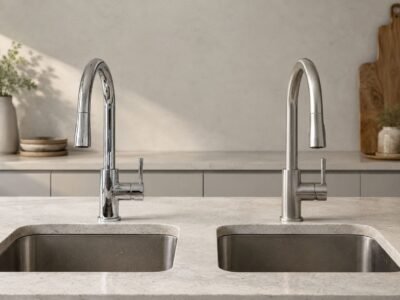
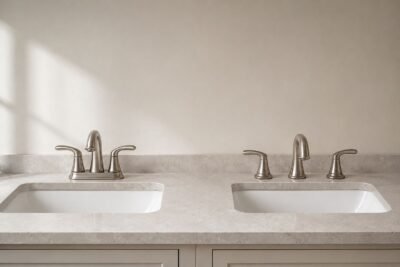
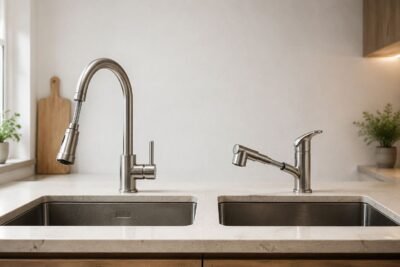
Your faucet shouldn’t wiggle when you touch it. If it does, it’s more than a “small annoyance.” That rocking motion works like a tiny crowbar on your seal. Give it enough days, and you may get a drip…then a cabinet that smells weird.
I’ve been in the faucet industry for 10 years, and I write about this stuff because I’ve seen the same problem ruin perfectly good kitchens. Let’s fix it.
If your current faucet keeps loosening or feels flimsy, it might be time to upgrade to a sturdier mount. I keep my most reliable options here: kitchen sink faucet collection.
Tools, Parts, and Safety Prep
Identify Your Faucet Setup
Look from above. Single-hole or 3-hole with a cover plate? Pull-down sprayer or not? These details change what’s holding the faucet down.
If you’re unsure, don’t worry—once you see the hardware under the sink, it becomes obvious.
If you want a quick visual of what’s happening under the sink—shank, mounting nut, bracket, and washers—I broke it down in faucet anatomy and mounting parts.
Essential Tool Kit
I keep it simple: basin wrench, adjustable wrench, flashlight, and a long Allen key.
That’s the same “go bag” I use when I’m installing or testing A-TORNEIRA faucets. It saves time and knuckles.
Safe Workspace Setup
Turn off both shutoff valves. Open the faucet to release pressure.
Put a towel and small bucket under the lines, and plug the drain (tiny screws love to disappear).
The 30-Second Diagnosis
Wobble at the base? Mounting hardware. Handle-only wobble? Set screw/handle hub. Loose spout? Spout retainer or O-rings.
That’s enough to aim you at the right fix.
And if you’re still deciding what style fits your home best, my guide on single-handle vs double-handle faucet choices makes it super clear.
Surface Protection by Material
Thin stainless can flex. Stone edges can chip.
I often add painter’s tape around the base before I start. Quick, clean, and protective.
How to Tighten a Loose Faucet Base (Deck-Mounted)
This is where most real fixes happen. If I had to bet money, your wobble is here.
Accessing the Mounting Hardware Under the Sink
Open the cabinet. Look up with a flashlight.
You’re hunting for a mounting nut, a bracket (often a U-shaped “horseshoe”), and washers. Some setups are metal, some are plastic.
Scene #1: I once worked under a sink with a huge garbage disposal. My shoulder was jammed against the cabinet wall, and the basin wrench could only turn one “click” at a time. I remember thinking, “Who designed this space? A squirrel?” Still—slow clicks worked.
Before you tighten anything, feel the faucet from above. If it spins easily, the clamp underneath is loose or mis-stacked.
Crowded cabinet? Pull-down hoses and weights can make tightening harder. If you’re shopping for a cleaner, easier setup, browse pull-down kitchen faucet options—they’re built for real-life under-sink chaos.

Mounting Styles Explained
Most deck-mounted faucets clamp down using one of these styles:
A classic big nut with a bracket under the sink, a quick-mount collar/clip system, or a cover plate setup that adds extra layers.
Cover plates matter because the “sandwich” is thicker. If a washer is missing or flipped, the faucet can wobble even if the nut feels tight.
If you see a large nut around the faucet shank, that’s the classic style. If you see tabs, a ring, or a clip, that’s usually quick-mount.
For the most stable, simplest installs, I’m still a fan of single-hole faucet designs—fewer parts, fewer chances for a “washer stack” mistake.
Modern Top-Mount Systems
In the 2024–2026 wave, more faucets let you tighten from above the sink, so you don’t have to fight for space under the cabinet.
You’ll usually see two designs: above-the-deck tensioning bolts or quick-secure toggles.
With tensioning bolts, you insert a long hex tool from the top and tighten—this pulls the mounting hardware up tight under the deck like a clamp.
With quick-secure toggles, tightening from above makes small locking arms flip out and grip the underside of the sink/counter fast.
A quick clue: if your faucet came with a long reach hex tool, or has a hidden top-access hole near the base, it’s probably this style.
Even with these “2026-friendly” systems, don’t rush. Tighten a little, check alignment, then finish—otherwise it can end up secure but slightly crooked.
Alignment Matters: Why You Need a “Spotter”
Here’s my favorite “pro move”: the two-person method.
One person stands above the sink and holds the faucet perfectly straight. The other person tightens below.
Why does this help so much? Tightening creates twist. Without a “spotter,” the faucet can slowly rotate as the clamp grabs.
Working alone? Tighten a little. Go up top. Straighten. Go back down. Repeat. It’s annoying, but it works.

Tightening Techniques in Tight Spaces
Seat the basin wrench fully on the mounting nut. If it’s half-on, you’ll round corners and hate life.
Tighten in small steps. I like a quarter-turn rhythm: tighten a bit, check the faucet above, tighten again.
Stop when the faucet no longer moves during normal use.
Don’t crank like you’re fixing a truck wheel. Over-tightening can crack plastic nuts, warp brackets, or bend thin sinks.
When Tightening Isn’t Enough
Sometimes the nut won’t tighten because something is damaged.
Look for stripped threads, cracked plastic parts, or a bracket that’s bent and won’t sit flat. Also check the gasket—if it’s crushed, torn, or missing, the faucet can rock even when “tight.”
If parts look worn, replace the mounting kit. Forcing bad threads is a time trap.
Common Mistakes to Avoid
I see these mistakes constantly:
Tightening while the faucet is crooked (it stays crooked). Missing washers. Flipped brackets. Twisted supply lines.
And one more: plumber’s tape does not stop wobble. Tape is for sealing pipe threads, not stabilizing a clamp.

The Role of Vibration
If your faucet keeps loosening, ask: “Is my sink shaking?”
Garbage disposals can vibrate. Thin stainless sinks can amplify that vibration. Over time, threaded parts can back off.
This isn’t just plumbing folklore. A classic engineering study by Gerhard Junker showed how vibration can cause self-loosening in fasteners, which is why locking methods exist at all.
If your disposal rattles, fix that too. Otherwise you’ll be tightening the faucet again soon.
Fixing Handle Wobble and Spout Issues
Quick side note: if your faucet feels “weird” after tightening, it’s sometimes poor flow from a clogged tip. Before you blame the installation, check how to remove a faucet aerator safely.
Handle Repair: Locating Hidden Set Screws
Most loose handles come down to one small set screw.
Pop the decorative cap, insert the correct Allen key, and tighten snug. If the screw keeps backing out, check if the handle adapter is worn.
A worn adapter can’t grip well—no matter how “strong” you tighten.
Cartridge & Bonnet Nut
Some faucets have a retaining nut (often called a bonnet nut) holding the cartridge.
If it’s slightly loose, you may get wobble or a tiny seep near the handle. Go gently here. Over-tightening can make the handle feel stiff and can damage seals.
If leaking continues, it’s often time for a new cartridge or O-rings.
If you’re at that point, I walk through cartridge replacement steps in a simple 15-minute guide.
Loose Swivel Spout
If the spout swings too freely or rocks at the base, the spout retainer may need tightening.
If it feels gritty, or you see water near the spout base, worn O-rings are a common cause.
Pull-Down Sprayer Special
If the spray head won’t seat, it can feel like something is loose.
Check the hose weight position. Too high or too low changes retraction. Also check the quick-connect under the sink—half-connected fittings can drip when the hose moves.
Advanced Troubleshooting and Long-Term Stability
Leaks After Tightening
Use leak location as your map: base leak = seal/gasket, under-sink leak = supply connection, handle leak = cartridge area.
Leaks are common. The U.S. EPA reports that 10% of homes have leaks that waste 90 gallons or more per day.
So yes—chasing a “small drip” is worth it.
Solving Chronic Looseness
If the sink flexes or the hole is oversized, add reinforcement (a wider plate spreads load). Less flex = less loosening.
This is also why I talk about mounting stability when people ask me about faucets, including A-TORNEIRA setups. A pretty faucet that moves is still a problem.
Resealing the Faucet Base
If your faucet has a factory gasket, use it.
If it doesn’t, a thin bead of silicone can block water from sneaking under the base—but it won’t replace proper tightening.
For professional installation and design guidance, I often point readers to the ASPE Plumbing Engineering Design Handbooks.
Post-Repair Checklist
Run hot and cold for 30 seconds. Move the handle. Swing the spout. Pull the sprayer.
Dry everything and do a paper towel test under the sink.
Scene #2: I once finished a late-night install and everything looked perfect—until the paper towel came back with a tiny wet dot near a supply fitting. One small snug saved that cabinet from swelling and smelling like a swamp.
Check again after 24 hours. Some gaskets settle after first use.

Pro Tips: When to Call a Plumber
Red Flags You Shouldn’t DIY
Call a pro if you see heavy corrosion, stuck shutoff valves, or signs of cabinet water damage.
If you smell mold or see swollen wood, don’t wait. That problem grows quietly.
Preventive Maintenance to Keep Hardware Rock-Solid
Once a year, take 60 seconds to look under your sink.
Touch the mounting nut, check for moisture, and make sure hoses aren’t rubbing sharp edges.
If you prefer separate hot/cold control (and easier handle servicing later), take a look at two-handle kitchen faucet styles—they’re a practical choice for many families.
If you catch looseness early, it’s a quick fix. If you ignore it, it can turn into a repair bill that hurts.