If you’ve ever wrestled a heavy stockpot into a cramped sink just to fill it with water, you already know why pull-out kitchen faucets have become so popular. They’re not just a design trend — they solve real problems in real kitchens every single day.
Over the years, I’ve swapped out more kitchen faucets than I can count, and the one upgrade that consistently gets the biggest reaction from homeowners is the pull-out. Not because it looks fancy (though it often does), but because it changes how you use your kitchen.
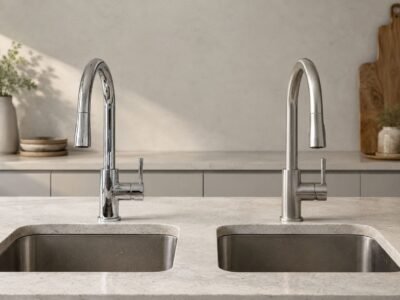
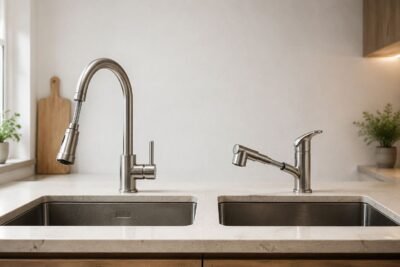
A pull-out kitchen faucet has an integrated spray head that undocks from the end of a relatively low-profile spout and extends forward on a flexible hose. Unlike a pull-down model, which is designed to move downward from a high-arc spout, a pull-out faucet is generally better suited to compact sinks and areas with limited vertical clearance. For a closer comparison of spout height, hose movement, sink compatibility, and everyday handling, see our guide to pull-down vs. pull-out kitchen faucets.
Here’s a quick overview of the main benefits and potential tradeoffs before we look at each one in detail.
Pull-Out Kitchen Faucet Benefits at a Glance
| Feature | Main Benefit | Potential Limitation |
|---|---|---|
| Lower-profile spout | Fits more easily beneath low cabinets, shelves, or windows | Provides less clearance for tall cookware |
| Flexible hose | Reaches sink corners and containers beside the basin | Requires unobstructed space beneath the sink |
| Integrated spray head | Offers more precise rinsing and directional control | Hose and docking components may wear over time |
| Multiple flow modes | Makes it easier to switch between filling and rinsing | Spray functions vary between models |
| Combined faucet and sprayer | Can eliminate the need for a separate side sprayer | Does not replace a soap dispenser or filtered-water faucet |
| Forward pull-out movement | Often works well with compact or shallow sinks | May feel less natural than a pull-down faucet in a deep sink |
These benefits depend on the faucet’s dimensions, hose design, docking quality, and compatibility with your sink. Let’s look at each advantage more closely.
Extended Reach and Flexible Movement
Reach Every Corner of the Sink
A fixed spout provides limited control over where the water lands. You can move dishes and cookware beneath it, but rinsing the corners, edges, and far side of a double-basin sink often requires awkward repositioning.
A pull-out spray head gives you much more directional control. You can extend the hose and aim the water into corners, around the drain, or along the sides of the basin without repeatedly moving large cookware.

Fill Pots on the Counter Without Lifting
With a fixed faucet, filling a large stockpot may require lifting it into the sink, positioning it beneath the spout, and lifting it out again after it becomes heavy. A pull-out faucet can often reach a pot placed on a stable section of countertop beside the sink, reducing the need to lift a full container.
Keep the pot close to the basin and never leave it filling unattended. An overflow outside the sink can damage cabinets, flooring, or moisture-sensitive countertop materials.
Direct Water Exactly Where You Need It
The precision alone is a huge plus. Want to rinse a single utensil without turning the whole sink into a splash zone? Pull the head out and aim it exactly where you want it. Need to spray down a colander of berries without blasting them across the room? The control is right in your hand.
Better directional control may help you complete some rinsing tasks more quickly, but the pull-out mechanism itself does not make a faucet water-efficient. According to the EPA’s Kitchen Faucets Technical Sheet, federal standards limit kitchen faucets to a maximum flow rate of 2.2 gallons per minute at 60 psi, while many models designed for greater efficiency are rated between 1.5 and 1.8 GPM.
The EPA also notes that WaterSense does not currently have a product specification for kitchen faucets and that some states and municipalities impose stricter flow-rate requirements. If water efficiency is important to you, compare the faucet’s rated flow rate, check applicable local standards, and confirm whether any temporary boost mode automatically returns to the normal flow setting after use.
Looking for a faucet with flexible forward reach and a lower-profile spout? Explore our pull-out kitchen faucet collection to compare hose reach, spray modes, spout dimensions, finishes, and other features for compact and standard kitchen sinks.
A Lower-Profile Option for Kitchens With Limited Clearance
Why Lower-Profile Spouts Can Work Well in Small Kitchens
Many pull-out faucets use a lower or mid-height spout than typical pull-down models. This can make them a practical option for kitchens with low cabinets, shelves, or windows above the sink. However, dimensions vary by model, so check the overall faucet height, spout reach, handle-to-backsplash clearance, mounting-hole configuration, and available space beneath the sink.
The tradeoff is that a lower spout may provide less clearance for tall stockpots and oversized cookware. Before ordering, follow these steps to check whether a faucet is compatible with your sink rather than relying only on product photos or general labels such as “compact.”
Plenty of kitchens I’ve worked on have a cabinet hanging low over the sink, leaving maybe 14 or 15 inches of clearance. A tall pull-down faucet simply won’t fit. A pull-out slides right under, no problem.
Can Fit Where High-Arc Faucets Create Clearance Problems
A high-arc faucet can obstruct the view through a low kitchen window or interfere with an inward-opening casement window. A lower-profile pull-out model may avoid that conflict, but the actual faucet height and window-opening path should be measured before purchase.
In compact kitchens, I prioritize the faucet’s overall height, spout reach, handle clearance, hose movement, docking mechanism, and replacement-part availability rather than choosing by appearance alone. I also look for products certified to the ASME A112.18.1/CSA B125.1 Plumbing Supply Fittings standard, which covers kitchen, sink, and lavatory supply fittings.
Certification does not tell you whether a faucet will fit a particular sink or whether its hose will feel comfortable in daily use. However, it provides a more meaningful technical baseline than relying only on product images, finish names, or general claims such as “premium quality.”
Less Splash in Shallow Sinks
Shallow sinks — often found in older homes or compact kitchens — are splash machines. Drop a stream of water from a high-arc spout into a 6-inch-deep basin, and you’ll be wiping down the backsplash every time you do dishes.
Moving the spray head closer to the rinsing surface can reduce the distance the water falls, which often helps control splashing in a shallow sink. However, splash also depends on the flow rate, stream angle, sink depth, and where the water lands.
For the best results, choose a spout reach that places the normal water stream near the center of the basin rather than directly against the front or rear wall.

Spray Modes for Common Kitchen Tasks
Stream vs. Spray: When to Use Each
Most pull-out faucets come with at least two modes: a steady stream for filling and a wider spray for rinsing. Sounds simple, but using the right mode at the right time makes a real difference in how fast you get through cleanup.
The stream setting is typically used for filling pots, pitchers, and coffee makers because it delivers a concentrated flow with less overspray. Flow strength and temporary boost functions vary by model, so check whether the advertised flow rate applies to every mode or only to the standard setting.
The spray setting distributes water through multiple jets, making it useful for rinsing dishes, produce, and food residue from cookware. Spray patterns vary by model, so look for a pattern that offers useful coverage without excessive misting or overspray.
Aerated Stream for Comfortable Everyday Use
On many kitchen faucets, the regular stream is aerated, while the spray mode uses multiple separate jets. Mixing air into the standard stream can make the flow feel fuller and may help reduce splashing, but actual water savings depend mainly on the faucet’s rated flow rate and how long it is left running.
An aerator or lower rated flow can reduce the amount of water delivered per minute, but real-world consumption also depends on how long the faucet remains open. A peer-reviewed field study published in Science of the Total Environment analyzed approximately 13,000 high-resolution tap-use observations and found that water consumption was strongly related to the duration of each use event. In that study, the lower-flow taps did not produce lower average consumption per event because users operated them for longer.
The study examined basin taps in institutional washrooms rather than pull-out faucets in residential kitchens, so its results should not be treated as a direct product comparison. However, it supports an important buying principle: rated flow is only one part of water efficiency. The faucet must also provide a practical stream and spray pattern that allow everyday tasks to be completed without unnecessarily extending the running time.
It Can Eliminate the Need for a Separate Side Sprayer
A pull-out faucet combines the main spout and handheld spray function in one fixture, so it can eliminate the need for a separate side sprayer. Depending on the existing sink configuration, this may free one deck hole and reduce the number of hose connections beneath the sink.
It does not replace a soap dispenser or a dedicated filtered-water faucet unless the selected model specifically includes those functions.
The integrated design reduces countertop clutter, but it does not eliminate every maintenance point. The retractable hose remains a moving component and may eventually develop stiffness, surface wear, connection leaks, or incomplete retraction. These symptoms do not always mean the entire faucet needs to be replaced; in many cases, you can replace the kitchen faucet sprayer hose while keeping the faucet body and spray head in service.
Everyday Uses Beyond the Sink Basin
Watering Plants and Filling Pet Bowls
Here’s one of the least obvious benefits, and honestly the one I use most: that hose reaches way beyond the sink.
I keep houseplants in my kitchen windowsill. Watering them used to mean filling a can at the sink, carrying it over, spilling half of it on the floor. Now I just pull the hose out, stretch it to the window, give each plant a quick drink. Same for the dog’s water bowl — pull, fill, done. No lifting, no spilling.
Fill Containers Beside the Sink
A pull-out spray head can also make it easier to fill pitchers, watering cans, buckets, and countertop appliances positioned beside the sink, provided they are within the hose’s reach and resting on a stable, water-resistant surface.
Keep electrical appliances switched off and unplugged when adding water, and follow the appliance manufacturer’s instructions.
Easier Rinsing of Oversized Cookware
Sheet pans, oven racks, and other oversized items can be difficult to position beneath a fixed spout. With a pull-out spray head, you can hold the item over the basin or an adjacent drainboard and direct water across a larger area without constantly rotating it.
Aim the spray back toward the sink and keep the item close to the basin to prevent water from reaching the countertop edge, cabinet fronts, or floor.
FAQ
Q1: What is the difference between pull-out and pull-down faucets?
Pull-out faucets usually have a lower-profile spout and a spray head designed to extend forward, making them well suited to compact sinks and limited overhead clearance. Pull-down faucets usually use a high-arc spout and a spray head that pulls downward, which often provides more working room in deep or wide sinks.
Q2: Do pull-out faucets work better in small kitchens?
Often, but not automatically. Many pull-out faucets have a lower profile that works well beneath cabinets, shelves, and windows. However, some models are still relatively tall, and a low spout may provide less clearance for large cookware. Check the actual faucet and sink dimensions before buying.
Q3: Can I install a pull-out faucet myself?
A straightforward like-for-like replacement may be suitable for an experienced DIYer with working shutoff valves, compatible mounting holes, and accessible supply connections. Professional installation is the safer choice if the valves are corroded, the plumbing must be modified, the faucet includes electrical components, or the area beneath the sink is difficult to access.
Ready to start shopping? My guide on how to choose the best kitchen faucet for your sink walks through everything from hole spacing to finish options.
A pull-out kitchen faucet is a strong option when you need more directional reach, have limited clearance above the sink, or regularly fill containers beside the basin. Its lower-profile design and integrated spray head can make everyday rinsing and cleanup more convenient.
It is not automatically the best choice for every kitchen. A pull-down faucet may offer more room for tall cookware and may feel more natural in a deep, wide sink. Before buying, compare the spout height and reach, hose movement, docking system, rated flow, sink depth, and available space beneath the countertop.

Whenever possible, test the faucet in person. Pull out the spray head, check how smoothly the hose moves and retracts, test the spray controls, and make sure the head docks securely. Those details usually matter more in daily use than appearance alone.
Still comparing different designs? Browse our kitchen sink faucet collection to compare pull-out, pull-down, touchless, and other configurations by spout height, handle style, finish, and sink compatibility.